
Situational Pricing: Last Invoice, Customer Expectation, Competition and Tactics
The prices that come from a situation rather than a price list — last invoice, customer expected, meeting-competition and tactical pricing.
In short
Some prices come from a situation rather than a price list. Last invoice price is what this customer paid last time. Customer expected price is what they believe they should pay. A meeting-competition price responds to a rival's offer. A tactical price is a deliberate short-term move. Each is legitimate; each leaves a trail that has to be reconciled later.
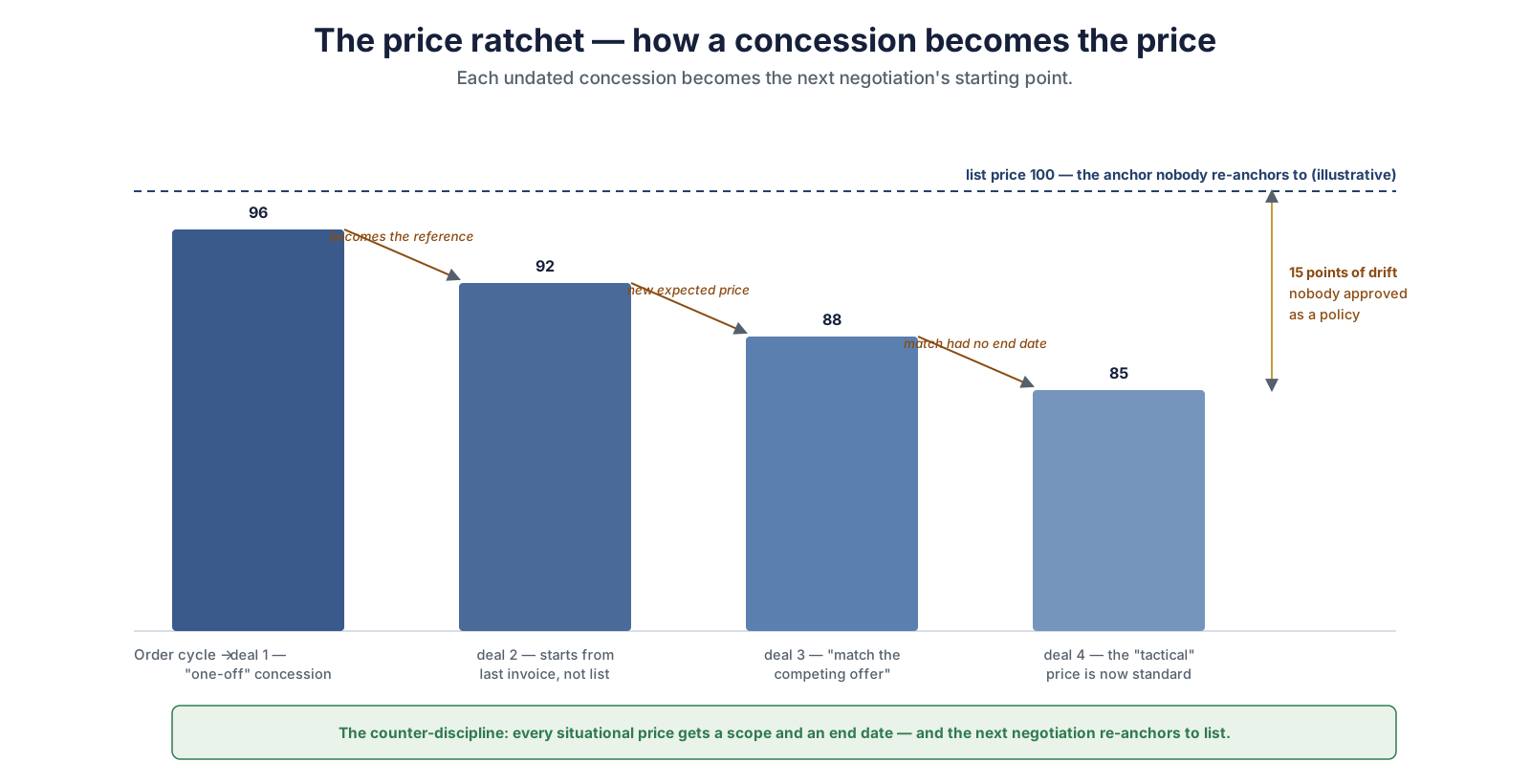
The prices in the previous two articles come from documents — a published price list or a negotiated agreement. This article is about the prices that come from a moment: what the customer paid last time, what they expect, what a competitor just offered, what this quarter needs. All four are legitimate instruments. All four are corrosive when nobody writes down their scope and end date.
The four situational prices at a glance
| Price type | Where it comes from | When it is used | The risk it creates |
|---|---|---|---|
| Last invoice price | This customer's most recent purchase | Day-to-day repeat selling | Becomes the new ceiling; prices ratchet down |
| Customer expected price | The buyer's belief, built from past deals and market talk | Every negotiation, whether you acknowledge it or not | One-off concessions reset the expectation permanently |
| Meeting-competition price | A rival's offer for the same business | Defending an account or a deal | A match with no end date is a permanent cut |
| Tactical price | A deliberate short-term commercial objective | Stock clearance, territory entry, seasonal push | "Short-term" quietly becomes standard |
Last invoice price
Ask a sales team what a customer's price is and the honest answer, most days, is whatever the last invoice says. It is the most commonly used reference in day-to-day selling for good reasons: it is real, it is specific to this buyer, and neither side has to reopen a negotiation to use it.
The cost is the ratchet. The list price is supposed to be the anchor that every discount is measured from; the last invoice price replaces it one order at a time. Give a one-off 4 per cent on a slow month (illustrative, like every figure here) and the next order starts from that number — the concession has become the ceiling. Nobody re-anchors to list, because re-anchoring means asking the customer for a price increase they will experience as unprovoked. Repeat across a few cycles and the account's realised price has stepped down by an amount nobody ever approved as a policy — which is exactly what the diagram above shows, and what a price waterfall review surfaces after the fact.
The discipline is not to ban the reference — it is to know, on every deal, both numbers: what they paid last time and where that sits against list.
Customer expected price
The customer expected price appears on none of your documents, which is why it gets managed by accident. It is the price the buyer believes they should pay, assembled from their invoice history, quotes they have collected, what their peers say they pay, and general market talk.
Expectation behaves like a one-way valve: it adjusts down instantly and up grudgingly. A concession granted once, without a stated reason, becomes the expectation; a concession granted with an explicit reason and an end date — "this is for the monsoon clearance, until the end of August" — leaves the expectation roughly where it was, because the buyer can see the price and the situation are attached to each other.
That is the practical management lever. You rarely control what competitors quote or what peers claim; you fully control whether your own concessions arrive labelled or unlabelled. Unlabelled concessions are how an off-invoice scheme's value quietly migrates into the base price, paying twice for the same behaviour.
Meeting-competition price
Sooner or later a customer arrives with a rival's offer and asks you to meet it. Matching is a commercial decision like any other, and the quality of the decision depends on three questions asked before the match, not after:
Is the offer real? A verbal "they quoted less" is not a quote. It is reasonable to ask to see the essentials before repricing against them.
Is it like-for-like? A lower price on a different grade, a different pack, different payment terms, different freight responsibility or a bonded versus duty-paid basis is not the same price. Most "cheaper" offers stop being cheaper when the specification is aligned.
Is the match one-off or ongoing? This is the question that decides the cost. Matching one order to hold an account during a competitor's push is a bounded expense. A match with no end date is a permanent price cut that will also become this customer's expected price — and, through market talk, their neighbours'.
One boundary, stated once: how you respond to competition on price is a commercial judgement, and nothing here is a statement about competition law — if a question of what is lawful arises, take legal advice.
Tactical pricing
A tactical price is a short-term price set to do a specific job: clear seasonal stock before expiry (the standing problem in seasonal agrochem channels), enter a territory, defend a key account through a competitor's launch, or load the channel ahead of a season — though where the loading is volume-linked, a quantity purchase scheme does the same job with the discipline built in. Unlike the first three, it is proactive — you chose it, it was not extracted from you.
What makes tactical pricing safe is the same discipline that makes a trade scheme settle cleanly:
- A defined start and end date, set when the price is approved — not negotiated at expiry.
- A defined scope — which customers, which products, which geographies.
- A plan to return to standard price, treated as a scheduled event, with the lapse communicated the same way the launch was.
A tactical price with those three properties is a campaign. Without them it is a price cut wearing a campaign's clothes, and in a multi-tier channel it propagates: a temporary distributor price becomes the dealer's assumed cost base, and unwinding it means renegotiating every tier at once.
The common thread: situational prices need an end date
Run the four back to back and the pattern is visible. Each one is defensible when it is recorded, scoped and time-boxed — and corrosive when it silently becomes the standard price. The last invoice ratchets, the expectation resets, the match outlives the rival's offer, the tactical push never lapses. Different doors, same room.
The damage shows up later, in two ledgers. In the margin ledger, as erosion the price waterfall reveals only in aggregate, quarters after the concessions were given. And in the claims ledger: an undocumented situational price is a rate-difference claim waiting to be raised, because the customer remembers the concession as permanent and your billing system never knew about it at all. The gap between those two memories lands on the claims desk, where it is argued from emails — or, where the buyer simply pays what they believe they owe, it arrives as a deduction instead — the least controllable of the three post-sale recovery shapes.
Recording the decision
The fix costs one minute at approval time. For every situational price, capture:
- who approved it,
- on what basis — the situation it responds to,
- for which customers and products,
- valid until when.
With that record, the concession can be honoured exactly and lapsed cleanly, and a later claim against it can be validated instead of argued. ClaimDS keeps commercial agreements and scheme terms as dated, scoped records that claims are validated against — which is precisely the treatment an approved situational price needs. <!-- TODO FOUNDER CONFIRM: capability sentence — confirm scope wording matches shipped functionality before publish. -->
The four situational prices are not the enemy — unrecorded ones are. Price to the situation when the situation calls for it; just make sure the price knows when the situation ends.
This article is general information about commercial practice, not legal advice. It makes no statement about competition law; where a question of lawfulness arises in responding to competitors' prices, take advice from a qualified lawyer.
Frequently asked questions
What is last invoice price?
Last invoice price is the price a specific customer actually paid on their most recent purchase — the most commonly used reference in day-to-day selling. It is fast and defensible in the moment, but it silently replaces the list price as the negotiation anchor, which is how prices drift downward over successive orders without anyone approving a price cut.
What is a customer expected price?
It is the price the buyer believes is right, formed by their past invoices, competitor quotes and market talk. It is not on any of your documents, but it decides how the negotiation goes. Managing that expectation is part of pricing — and a one-off concession given without a stated reason and end date resets the expectation permanently.
What is meeting-competition pricing?
It is a price set to respond to a rival's offer for the same business — a commercial decision to defend an account or a deal. The practical tests before matching: is the competing offer real, is it like-for-like on specification and terms, and is the match a one-off or ongoing? A match given without an end date becomes a permanent price cut.
What is tactical pricing?
A tactical price is a deliberate short-term move — clearing stock, entering a territory, defending an account, a seasonal push. What makes it tactical rather than a drift is discipline: a defined start and end date, a defined scope of customers and products, and a plan to return to the standard price when it lapses.
Why do prices drift downward over time?
Because each concession becomes the next negotiation's starting point. When the reference is the last invoice rather than the list price, every one-off discount resets the baseline, and the buyer's expected price ratchets down with it. The drift is rarely approved as a policy — it accumulates one undated concession at a time, and it surfaces later as margin erosion.
How long should a tactical price last?
It should have a defined end date set at the moment it is approved — that is what separates a tactical price from an unplanned price cut. The right length depends on the objective: long enough to do its job, short enough that reverting is a scheduled event rather than a negotiation. An open-ended tactical price is simply the new price.
See ClaimDS on your own claims data
A 30-minute walkthrough tailored to how your channel actually settles claims.
Related posts
Bonded vs Non-Bonded Warehouse Pricing: Why the Same Goods Carry Two Prices
Why the same imported goods carry different prices in a bonded and a non-bonded warehouse, and what that means for quoting, costing and margin.
Contracted, Customer-Specific and Grade Pricing: How Negotiated Prices Work
Negotiated prices — contracted, customer-specific and grade-based — and the claims and reconciliation work each one creates.
List Price, MRP, Brochure Price and Reseller Price: What Each One Means
The published prices in a channel — list, MRP, brochure and reseller price — and what each one actually commits you to in India.