Reconciling Invoice Data Against the Agreement Before You Pay a Claim
A claim is only valid if the invoices behind it meet the agreement behind it. The checks that belong between receiving a claim and settling it.
In short
Validating a claim means testing the invoices behind it against the agreement behind it — right party, right period, right products, right quantities and values, right scheme version, and nothing already claimed. Each check is simple; doing them consistently on every claim is what prevents both overpayment and disputes.
Validating a claim means testing the invoices behind it against the agreement behind it — right party, right period, right products, right quantities and values, right scheme version, and nothing already claimed. Each check is simple; doing them consistently on every claim is what prevents both overpayment and disputes.
This sits between receiving a claim and settling it — the validation step. It overlaps with, but is distinct from, deduction management, which handles short-payments the counterparty has already taken; here the money has not yet moved.
| Check | What it tests | What it catches |
|---|---|---|
| Party eligibility | Is this counterparty enrolled in this scheme? | Claims from parties outside the scheme |
| Period alignment | Do the invoices fall inside the scheme period? | Out-of-period invoices inflating the base |
| Product scope | Are these SKUs in scope for the scheme? | Out-of-scope products claimed |
| Quantity / value thresholds | Is the slab reached and correctly applied? | Wrong slab, over-stated achievement |
| Rate applied | Does the rate match the agreed slab? | Top rate applied to the whole base wrongly |
| Duplicate check | Were these invoices already claimed? | The same invoice paid twice |
| Returns and credit notes | Has the base been reduced for reversals? | Gross base where it should be net |
| Scheme version | Was the correct version of the terms applied? | An amended scheme re-rating history |
| Cap and budget | Does this exceed the scheme cap? | Payout beyond the sanctioned amount |
Why the agreement is the control document
A claim is an assertion of entitlement. The agreement is what defines that entitlement. Without one authoritative version of the agreement to test against, validation is not checking — it is opinion, and two people with two copies of the circular will reach two answers.
This is why the agreement has to be a single, versioned record rather than a PDF that circulated by email and a tracker the sales team maintains separately. The claim is measured against it, so if "it" is ambiguous, every downstream check inherits the ambiguity. Everything in the validation table above assumes there is one definitive statement of terms to validate against; establishing that is the precondition, not a detail.
The checks that catch the most
Three of the nine catch a disproportionate share of the money, and they are worth doing well before the others:
Duplicates. The same invoice supporting two claims is pure overpayment, and it happens constantly — a claim submitted once by email and once through a portal, a resubmission after a query treated as new. The check is mechanical (match underlying invoices against what has already been claimed) and the payoff is direct. Illustratively: a single duplicated ₹50,000 claim line paid twice is ₹50,000 gone, caught by one comparison.
Period boundaries. An invoice from just outside the scheme window, counted inside it, inflates the base and the payout. The failure is quiet because the invoice is genuine — only its date disqualifies it. The check is that every invoice in a claim falls inside the period whose terms are applied.
Returns not netted. A sale later reversed did not happen for scheme purposes, so a claim computed on the gross figure over-rewards. The check confirms that credit notes and returns in the period have reduced the base — the same discipline behind clawbacks on returns. (All figures illustrative; the mechanism is the point, not any specific number.)
Handling exceptions without stopping settlement
The instinct to hold an entire claim because one line is questionable is expensive and unnecessary. Where most of a claim validates cleanly, approve the validated portion and query only the rest.
Part-approval does two useful things: it keeps cash moving on what is genuinely owed, and it narrows the dispute to the specific rows in question instead of freezing the whole claim over them. The queried lines go back with a clear reason; the clean lines settle. This is how a high-throughput claims operation avoids the query loop swallowing good claims along with doubtful ones — the throughput pattern behind any large-scale claim settlement process.
Documenting the outcome
Validation that leaves no record is validation you cannot defend later. Each claim should carry what was approved, what was rejected, and on what basis — the specific check that failed, not just a status. That record is what lets a settlement be reconstructed under audit and what lets a distributor understand a partial payout without a phone call. It is the same evidence the maker-checker and audit trail discipline preserves, applied at the validation step.
Automating the checks
Every check in the table is a rule, and rules are what software applies consistently where humans apply them unevenly under time pressure. ClaimDS validates each claim against the versioned rebate agreement and the invoice-level base data — party, period, scope, slab, duplicates, returns netting, cap — settles or part-approves accordingly, and records the basis of every decision. Clean claims flow through; exceptions surface for a fast decision rather than a slow hold. The wider picture is in connected claims.
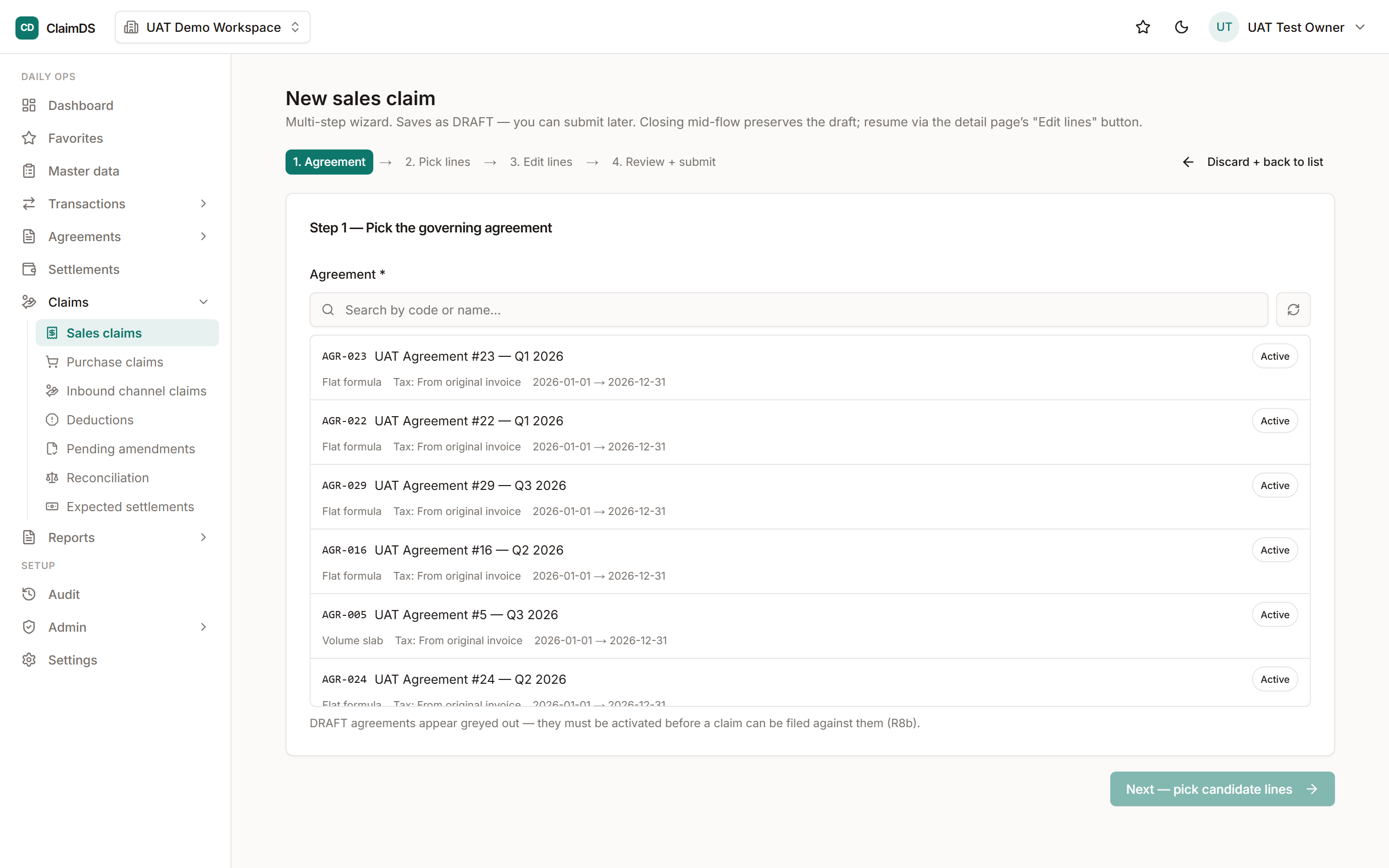
To run these checks against your own claims, book a demo.
Note: General information about validation practice, not tax or legal advice. Where a claim's GST or credit-note treatment arises, see our tax articles and confirm positions with your adviser.
Frequently asked questions
How do you validate a distributor claim?
By testing the invoices behind the claim against the agreement that defines it: is the party enrolled in this scheme, do the invoices fall in the scheme period, are the products in scope, is the slab correctly applied to the right quantities and values, is the correct scheme version used, and has none of it been claimed before. A claim passing all of those is payable; one failing any is an exception.
What checks prevent duplicate claims?
Matching each claim's underlying invoices against those already claimed, so the same invoice cannot support two claims. This needs stable document numbers and a record of what has been settled. Duplicates arise innocently — a claim submitted twice through different channels — and deliberately, so the check matters either way. It is one of the highest-value validations because duplicates are pure overpayment.
How are returns handled when validating a claim?
By netting them out of the claim base before the scheme rate is applied. A sale that was later returned did not really happen for scheme purposes, so counting it overstates the achievement and the payout. Validation checks that credit notes and returns in the period have reduced the base, and flags claims where the gross figure appears not to have been netted.
What if a claim spans two scheme periods?
Split it, and validate each part against the terms of its own period. Blending invoices from two periods into one claim, computed against one period's slabs, produces a wrong number — especially where the slab or the terms changed between them. The check is that every invoice in a claim falls inside the period whose terms are being applied, and mixed-period claims are separated.
Can part of a claim be approved?
Yes, and usually it should be. Where most of a claim validates cleanly and a portion is in question, approving the validated part and querying only the rest settles what is owed promptly instead of holding the whole claim over one line. Part-approval keeps cash moving and narrows the dispute to the specific rows that need a decision, rather than freezing everything.
What is a scheme version and why does it matter?
A scheme version is the exact set of terms — slabs, eligibility, caps, dates — in force at a point in time, since schemes are often amended mid-life. It matters because a claim must be validated against the version that applied when the sales were made, not the version as it reads today. Without versioning, an amended scheme silently re-rates history and validation becomes unreliable.
See ClaimDS on your own claims data
A 30-minute walkthrough tailored to how your channel actually settles claims.
Related posts

What Faster Claim Settlement Is Worth: Claims, Cash and Working Capital
An unsettled claim is your money sitting in someone else's system. How settlement speed affects a distributor's working capital, with worked examples in rupees.
Connected Claims: How Invoice and Sales Data Moves Between Your ERP, Your Brands and Your Claims
How invoice and secondary-sales data moves between a distributor's ERP, the brand, and the claim settlement — file upload, direct connection, and what each is good for.
Exporting Sales and Purchase Invoices from Tally for Claim Settlement
How to get invoice data out of Tally in a form a claims workflow can use — what to export, which fields matter, and how to keep the data clean enough to reconcile.