Trade Promotion Management for Indian SMBs: What It Is and Why It Matters
What trade promotion management is, why it matters for small and mid-sized Indian businesses, how it helps them compete with larger brands, and how software reduces costly errors.
In short: trade promotion management (TPM) is how a business plans, runs, tracks and settles the schemes, discounts and incentives it offers its channel — distributors, dealers and retailers — to sell more product. It matters to Indian SMBs because trade spend is often the largest cost after the goods themselves, and on spreadsheets it leaks quietly. Managing it well is how a smaller brand competes.
What is trade promotion management, and why is it important for Indian SMBs?
Trade promotion management is the end-to-end process of planning a trade scheme, communicating it to the channel, tracking who qualifies, validating the claims that come back, and settling them accurately — usually through a credit note or payout. A "trade promotion" here means the money a brand spends down its channel to move product: quantity schemes, slab discounts, secondary-sales schemes, display and visibility support, and dealer or distributor incentives.
It is distinct from consumer advertising. Advertising reaches the shopper; trade promotion reaches the distributor and retailer who decide how much of your product to stock and push. For a fuller breakdown, see our guides on trade promotion in consumer goods, consumer promotions versus trade promotions and trade spend versus advertising.
Why it matters more for an SMB than for a large brand
For a large FMCG company, trade spend is heavily managed by a dedicated commercial-finance team with enterprise software. For a small or mid-sized Indian business, the same schemes exist — but they are usually run by a small team on spreadsheets, reconciled by hand at month-end, and argued over on WhatsApp when a distributor disputes a claim.
That gap is the point. Trade spend is frequently one of the largest lines in the business after the cost of goods, and when it is managed informally it produces three predictable problems: margin that leaks without anyone noticing, claims paid that shouldn't have been, and no single number for what a scheme actually cost.
None of these are dramatic on any single transaction. They accumulate. A slightly over-paid claim here, a duplicate deduction there, a scheme that ran longer than budgeted — and over a year, a smaller business absorbs a cost it never planned for, straight off the bottom line. Managing trade promotion well is, for an SMB, mostly about making that invisible cost visible before it does damage — the same discipline mapped in where revenue leaks out of a rebate program.
How does trade promotion management help Indian SMBs compete with larger brands?
It levels the part of the game that is usually rigged in the large brand's favour: control over trade spend. A big brand's advantage in retail is not only bigger budgets — it is discipline. It knows precisely what each scheme costs, which distributors are profitable, and which promotions actually moved product. A smaller brand that runs its schemes on spreadsheets is flying blind by comparison, even when its products are just as good.
Bringing structure to trade promotion closes that gap in three concrete ways.
1. It protects the margin a smaller brand cannot afford to lose
A large brand can absorb a few percentage points of leaked trade spend. A smaller one often cannot — that leak can be the difference between a profitable quarter and a break-even one. Catching invalid claims, duplicate deductions and over-runs is proportionally far more valuable to an SMB. The same discipline that is a rounding error for a giant can be decisive for you.
2. It turns scheme data into a real decision-making advantage
When every scheme, claim and settlement is recorded in one place rather than scattered across spreadsheets, patterns become visible: which schemes drive real secondary sales, which distributors respond to which incentives, which promotions simply subsidised sales that would have happened anyway. That is the same visibility a large brand's commercial-finance team has — and it lets a smaller, faster business out-decide a bigger one. Our guides on primary, secondary and tertiary sales and calculating distributor claims go deeper on the data that makes this possible.
3. It builds trust with the channel
Distributors and retailers work hardest for brands that pay claims accurately and on time. A smaller brand that settles a distributor's claim quickly, with a clear statement of exactly how the number was calculated, earns loyalty that budget alone cannot buy. When a claim is disputed, having a defensible record — rather than a memory or a contested spreadsheet — is what keeps the relationship intact. In a market where a large competitor is fighting for the same shelf, a distributor who trusts you is a real competitive edge.
The honest version. Trade promotion management does not let a small brand out-spend a large one — it lets a small brand out-manage one. The advantage is control, visibility and trust, not budget. For an SMB, that is usually the only kind of advantage available in trade — which is exactly why it is worth taking seriously.
How can software reduce common trade-promotion errors?
Software reduces trade-promotion errors mainly by removing the two conditions that cause them: information scattered across spreadsheets, and validation done by hand after the money has already moved. Most trade-promotion mistakes are not exotic — they come from the same handful of structural weak points, and each one is addressable.
Where trade-promotion errors actually come from
| Common error | Why it happens on spreadsheets |
|---|---|
| Paying a claim that doesn't qualify | No single authoritative record of the scheme's terms to check the claim against |
| Paying the same claim twice | Nothing links a claim to the invoice or the settlement, so duplicates slip through |
| A scheme quietly over-running its budget | Spend isn't tracked against the scheme in real time; the over-run is discovered at month-end, too late |
| A dispute with no defensible answer | The calculation lived in one person's spreadsheet; when questioned, there is no clear audit trail |
| A settled claim not reversed when goods come back | A later return or credit note doesn't automatically claw back the incentive already paid |
How software addresses each one — structurally
The value of a purpose-built platform is not magic; it is that these checks become automatic and consistent instead of manual and occasional:
- One authoritative scheme record. The scheme's terms are defined once, and every claim is validated against them — so a claim that doesn't qualify is caught before it is paid, not after.
- Claims linked to invoices and settlements. Because a claim is tied to the transactions it relates to, duplicates and mismatches surface instead of slipping through.
- Spend visibility per scheme. Accruals and settlements are measured against each scheme as they happen, so an over-run becomes visible while there is still time to act.
- An audit trail on every settlement. Each payout carries a record of exactly how the number was calculated — which turns a dispute from an argument into a lookup.
- Reversals that follow the sale. When a return or credit note reverses a sale, the related incentive is reversed through the same disciplined process rather than being forgotten.
What software cannot do. A platform cannot design a good scheme for you, and it cannot fix a promotion that was a bad idea to begin with. It reduces execution errors — the leaks between deciding a scheme and settling it correctly. That is a large share of the money most SMBs lose in trade, but it is worth being clear about the boundary: better plumbing, not better strategy. The strategy is still yours.
This is the specific problem ClaimDS is built for — running channel schemes, claims and settlements for Indian manufacturers and distributors who need the discipline of enterprise software without the cost or complexity of it.
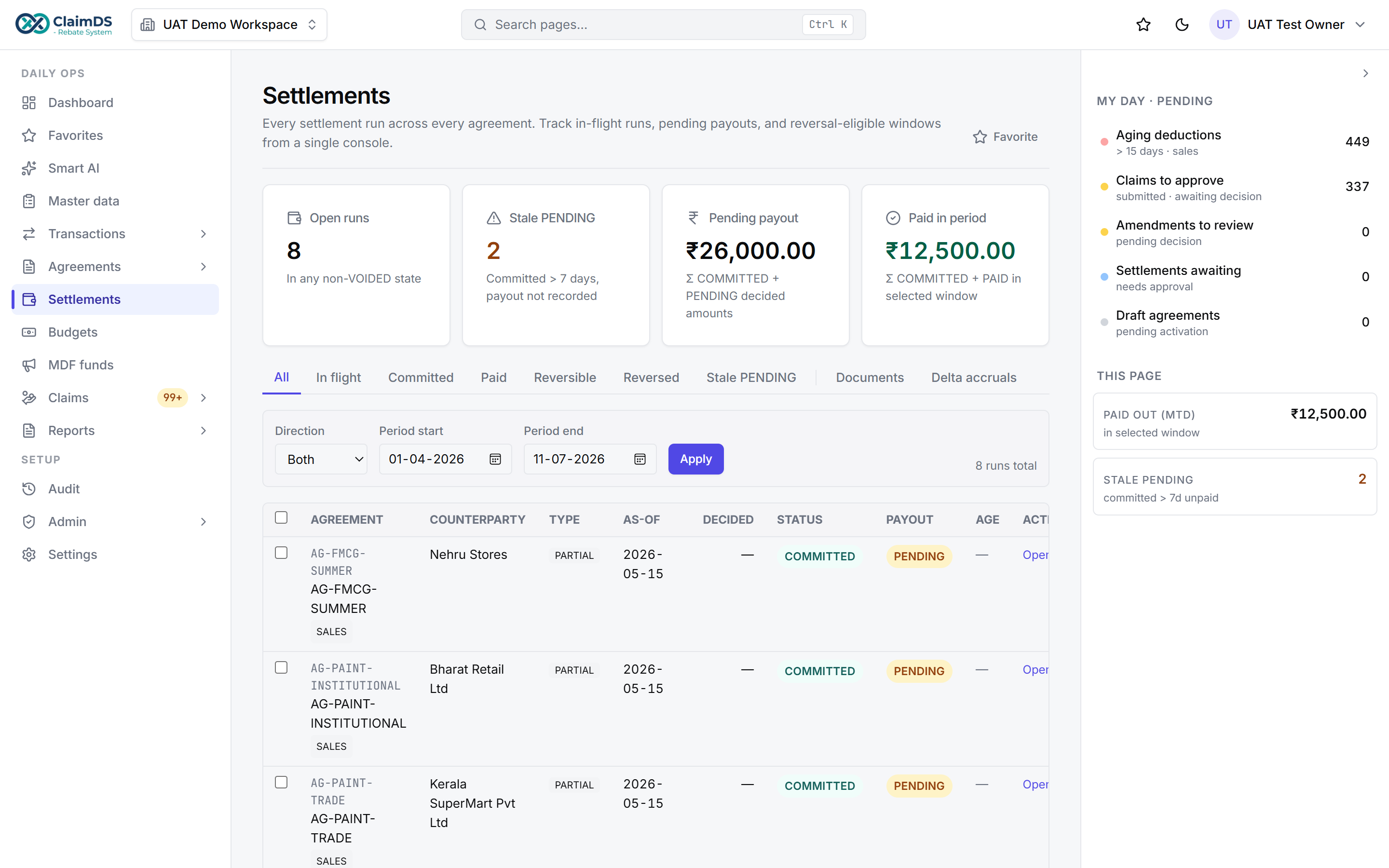
The ClaimDS settlement view — schemes, claims and settlements in one auditable place.
General information. This article explains trade promotion management in general terms for Indian businesses and is not tax, legal or accounting advice. Where a scheme has GST, TDS or accounting implications, confirm the treatment with your chartered accountant — see our GST guides for the specifics.
Read next
- How Indian SMBs can implement affordable trade promotion management — the implementation companion to this primer: framework, build-vs-buy and timelines.
- Trade promotion management, step by step — the process walkthrough.
- Trade promotion in consumer goods: a complete guide — the full trade-spend toolkit.
- Consumer promotions vs trade promotions — the shopper-facing vs channel-facing split.
- How to calculate FMCG distributor claims — the arithmetic behind accurate settlement.
ClaimDS runs channel schemes, claims and settlements for Indian manufacturers and distributors — the discipline of enterprise trade-promotion software, without the enterprise price.
Book a demo to see where your trade spend is actually going.
Frequently asked questions
Is trade promotion management the same as consumer advertising?
No. Advertising reaches the shopper; trade promotion reaches the distributors and retailers who decide how much of your product to stock and push. Trade promotion management covers the money a brand spends down its channel — quantity schemes, slab discounts, secondary-sales schemes, display support and dealer incentives — and the process of tracking, validating and settling it accurately.
Why is trade promotion management important for small and medium businesses in India?
Trade spend is often one of the largest costs after the goods themselves, and for Indian SMBs it is usually run on spreadsheets where it leaks through over-paid claims, duplicate deductions and budget over-runs. A large brand can absorb that leak; a smaller one often cannot. Managing it well protects margin the business cannot afford to lose.
How does trade promotion management help SMBs compete with larger brands?
It gives a smaller brand the control, visibility and channel trust that larger brands get from dedicated commercial-finance teams. It protects margin by catching leaks, turns scheme data into better decisions about which promotions and distributors actually work, and builds distributor loyalty through accurate, on-time, defensible settlements. It lets a small brand out-manage a big one rather than out-spend it.
What are the most common trade promotion errors?
The most common errors are paying claims that do not qualify, paying the same claim twice, letting a scheme over-run its budget unnoticed, being unable to defend a disputed claim, and failing to claw back an incentive when goods are returned. Nearly all of them come from information scattered across spreadsheets and validation done by hand after money has moved.
How does software reduce trade promotion errors?
By holding one authoritative scheme record to validate claims against, linking claims to invoices so duplicates surface, tracking spend against the scheme as it happens, keeping an audit trail on every settlement, and reversing incentives when the underlying sale reverses. It addresses execution errors between planning a scheme and settling it, though it cannot design the scheme for you.
Can a small business run trade promotions without enterprise software like SAP?
Yes. Enterprise suites are built for large brands and are usually too costly and complex for Indian SMBs. Purpose-built trade-promotion and claims platforms give a smaller business the same discipline — one scheme record, validated claims, budget visibility and defensible settlements — at a price and complexity suited to mid-market manufacturers and distributors.
See ClaimDS on your own claims data
A 30-minute walkthrough tailored to how your channel actually settles claims.
Related posts

Trade Spend vs Advertising: Where Your Promotion Money Actually Goes
Trade spend and advertising (A&P) are two different budgets that behave differently. What separates them, why finance teams confuse them, and how each is tracked.
Consumer Promotions vs Trade Promotions
Consumer promotions vs trade promotions — who each targets, who funds them, how they are measured, and why trade promotions create claims.
Painter and Contractor Loyalty Programs in India
How painter and contractor loyalty programs work in India — points, rewards and redemption, why brands run them, and the Section 194R tax pointer.