How Indian SMBs Can Implement Affordable Trade Promotion Management
A practical guide for Indian SMBs to implement affordable trade promotion management: codify schemes, automate distributor claims, and stay GST-compliant.
In short
Affordable trade promotion management for an Indian SMB means codifying schemes as structured rules, capturing and validating distributor claims against those rules, and settling by GST-compliant credit note — without an enterprise-suite budget. The payoff is control over what is often the second-largest P&L line after cost of goods.
Trade schemes are one of the biggest cheques an Indian manufacturer writes every quarter — and one of the least controlled. If you sell through distributors, dealers, or stockists, trade promotions are probably the second-largest line on your profit and loss statement after the cost of goods sold. You fund slab discounts, quarterly schemes, display and foam schemes, dealer incentives, price protection, and warranty or expiry claims — and most of it flows back to you as a pile of distributor claims to be checked, settled, and accounted for.
For large enterprises, this runs on expensive global software. For most Indian small and mid-sized businesses, it runs on spreadsheets, email, and the patience of an overworked finance team. That gap is exactly where money leaks. This guide walks through what a trade promotion management (TPM) system is, why it matters, a phased way to implement one affordably, the GST rules you cannot ignore in 2026, and the concrete benefits of getting it right. For the rebate-software angle on the same affordability question, see SMB rebate software for India.
A few numbers to set the scale:
- 15–25% of gross revenue — what Indian brands typically spend on trade promotions and advertising.
- ~59% of promotions don't break even — per Nielsen's global trade-promotion analysis.
- 5–10% leakage — the estimated share of trade claims lost through manual, spreadsheet-based processes.
These are industry and vendor estimates (Promotion Optimization Institute, Nielsen, and India-focused vendors). They are directional, not audited India-specific numbers.
What you actually get for the money
If you want the strategic case first — what TPM is and why it decides whether an SMB can compete with larger brands — start with the trade promotion management guide, then come back here for the implementation path.
A trade promotion management system manages the full life of a scheme across a multi-tier channel — from the moment marketing designs it to the moment finance closes the books on it. In an Indian network (manufacturer → super-stockist or C&FA → distributor or stockist → retailer → consumer), the lifecycle looks like this:
- Scheme design — define the mechanic, slabs, eligibility, period, and budget.
- Communication — publish the scheme to the field force and channel partners.
- Claim capture — the distributor who funded a secondary scheme upfront raises a claim to recover it.
- Validation — match the claim against scheme rules and, ideally, against secondary (sell-out) sales, not just primary (sell-in).
- Approval — route through sales, trade marketing, and finance.
- Credit note & GST treatment — settle through the correct credit note, with the right GST and input-tax-credit consequences.
- Payout — adjust against future invoices or pay out.
- Reconciliation & ROI — reconcile against accruals, then measure incremental margin per rupee of scheme spend.
Most Indian SMBs do steps 1, 2, and 7 reasonably well. It is steps 3 to 6 — capture, validation, approval, and GST-correct settlement — where spreadsheets quietly cost real money. (It's the same pattern behind why distributor rebate claims slip through the cracks.)
Why this is urgent for Indian SMBs right now
General trade — kirana stores, distributors, and wholesalers — still moves roughly 80% of FMCG volume in India, so channel-partner economics are not a side issue; they are the business. Three pressures make manual trade-scheme management increasingly painful:
- Leakage. Invalid and duplicate deductions are estimated at 5–10% of trade claims. On a trade budget that is a fifth of revenue, even a few percentage points is margin you fund twice.
- Working capital and trust. When a scheme a distributor funded in October is only settled in January, you have parked their cash and strained the relationship. Replacing a disengaged channel partner is far more expensive than keeping one.
- Blind spots. When only a minority of companies can measure trade spend at the level of a single event, you cannot tell a winning scheme from a wasteful one — so the waste repeats.
The affordable implementation framework
You do not need an enterprise budget or a two-year programme. A focused SMB can reach a working system in roughly three to six months by sequencing the work into phases and tackling the largest distributors and highest-value schemes first.
Phase 0 · Weeks 0–2 — Baseline what you have
Effort: low · Owner: finance + sales ops. List every active scheme, every claim type, your current settlement cycle time, and your dispute rate. You cannot improve what you have not measured. Good looks like: a documented scheme taxonomy and a baseline number for claim cycle time and estimated leakage.
Phase 1 · Weeks 2–6 — Standardise and codify schemes
Effort: medium · Owner: trade marketing + finance. Move every scheme into a structured, rules-based format — mechanic, slabs, eligibility, period, budget, and GST treatment — so no two regions run different logic in different spreadsheets. Good looks like: no scheme runs without a codified rule and a named owner.
Phase 2 · Weeks 4–10 — Digitise claim capture
Effort: medium · Owner: sales ops + channel. Replace email and Excel with structured digital claim submission, with supporting documents attached at source by the distributor. Good looks like: every claim captured digitally with a complete audit trail.
Phase 3 · Weeks 8–16 — Automate validation against secondary sales
Effort: higher · Owner: finance + IT. Auto-match each claim to its scheme rule and to secondary-sales data, flagging duplicates, expired-scheme claims, and over-claims. This is the leakage fix. Good looks like: most claims auto-validated, with only genuine exceptions reaching a human.
Phase 4 · Weeks 12–20 — Wire in GST-correct credit-note flows
Effort: medium · Owner: finance + tax. Route every settlement through the correct document — a financial/commercial credit note or a Section 34 tax credit note — with the input-tax-credit logic built in (see the GST section below). Good looks like: every settlement produces the right document type with a compliance trail.
Phase 5 · Weeks 16–24+ — Turn on dashboards and ROI
Effort: ongoing · Owner: finance + leadership. Track scheme ROI by region, SKU, and partner; claim ageing; and leakage. Good looks like: finance and sales share one source of truth, and weak schemes are cut in the same quarter they run.
Build, buy, or stay on spreadsheets?
There are really four options, and for most Indian SMBs only one makes sense:
- Spreadsheets are free but are the source of the leakage, delays, and disputes — they have no rules engine and no audit trail.
- Western enterprise suites are powerful but carry very high total cost of ownership, with heavy implementation and licensing usually justified only at large-enterprise scale.
- Building in-house diverts scarce IT resources and rarely keeps pace with GST change.
- Affordable, India-built purpose SaaS encodes Indian scheme types, GST credit-note logic, and secondary-sales reconciliation out of the box, deploys in weeks, and costs a fraction of enterprise software.
It is worth being honest about the market: India's leading sales-force-automation and distributor-management platforms are genuinely strong at field execution and secondary-sales tracking, and several offer scheme or claim modules. The white space — and the reason purpose-built tools exist — is depth of finance-grade, GST-compliant claim and rebate settlement: the classification, documentation, and reconciliation that keep an audit clean. (For the deductions side of that, see our distributor claim settlement software buyer's guide.)
The GST rules you cannot get wrong in 2026
This is where trade schemes stop being a sales problem and become a finance problem. The single most important distinction is between two kinds of credit note.
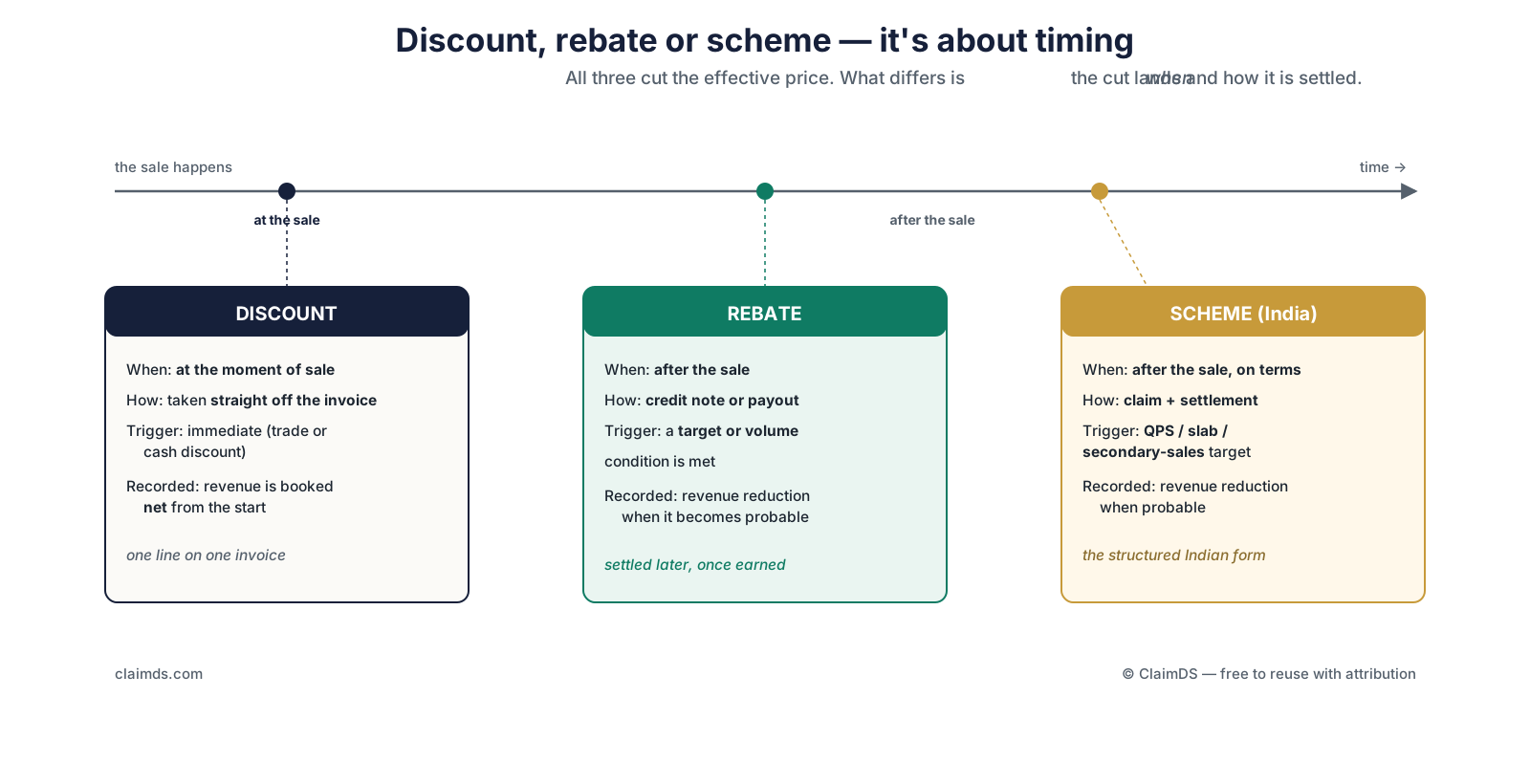
A tax (GST) credit note under Section 34 of the CGST Act reduces your output tax liability — and requires your distributor to reverse the proportionate input tax credit. A financial or commercial credit note is issued without GST: it reduces only the commercial value, leaves your tax liability unchanged, and does not require the distributor to reverse input tax credit.
What Circular 251/08/2025 confirmed. CBIC Circular 251/08/2025, dated 12 September 2025, clarified that when a supplier issues a financial or commercial credit note for a post-sale discount, the recipient does not need to reverse input tax credit — because the original transaction value and the tax on the original invoice are unchanged. It also clarified that a normal manufacturer-to-dealer post-sale discount is not consideration for the dealer's onward sale, and that a dealer's self-driven promotion is not a taxable service unless there is an explicit agreement with defined consideration for specific activities.
Under the law currently in force, to reduce your output tax on a post-sale discount through a GST credit note, that discount must be established under an agreement made at or before the time of supply, linked to specific invoices, with the input tax credit reversed by the recipient (Section 15(3)(b)). If a discount was not pre-agreed, the clean route today is a financial/commercial credit note — no output-tax reduction, but no input-tax-credit reversal for your distributor either.
Important: a change is enacted but not yet in force. The Finance Act 2026 substituted Section 15(3)(b) and amended Section 34 to simplify post-sale discounts — but as of June 2026 these provisions are not yet notified into force. Until the government publishes a commencement notification in the Official Gazette, the pre-agreement rule above still governs. Do not pre-apply the new rule. This article is general information, not tax advice — confirm the current position with a qualified professional before structuring schemes.
Getting the credit-note choice wrong has real consequences: issue a GST credit note for an un-pre-agreed discount under today's law and the output-tax reduction can be denied; treat a contracted promotional service as a mere discount and you can face a demand for GST on that service. This is precisely the judgment a finance-grade TPM system should encode as a rule rather than leave to a busy accounts team each month. (We go deeper on this in GST credit notes for rebates under Rule 53(1A).)
The benefits of implementing a TPM system
When an Indian SMB moves from spreadsheets to a purpose-built trade promotion management system, the returns show up across finance, sales, and the channel relationship:
- Plug revenue leakage. Automated validation against scheme rules and secondary sales kills duplicate, expired, and over-claims — recovering the estimated 5–10% that manual processes leak.
- Faster, fairer settlement. Claims that took weeks settle in days. Distributors see status in real time, freeing their working capital and rebuilding trust.
- Built-in GST compliance. The right credit note — financial or tax — is chosen by rule, with input-tax-credit logic handled by design and an audit trail for every settlement.
- Clear ROI on every scheme. See which schemes, regions, and SKUs actually pay back, cut the ones that don't in-quarter, and redirect budget to winners.
- One source of truth. Finance and sales work from the same scheme, claim, and accrual data — ending the month-end reconciliation standoff.
- Stronger channel loyalty. Transparent, timely claims make you a partner distributors want to stock and push — which is where the sales lift comes from.
- Audit-ready by default. Every scheme rule, claim, approval, and credit note is logged, so GST and statutory audits become routine rather than fire drills.
- Scales without headcount. Add distributors, SKUs, and schemes without adding spreadsheets or staff — the system absorbs the complexity.
Where to start
You can begin tomorrow, with or without software: list your active schemes, codify their rules, and measure your current claim cycle time and dispute rate. That single step — a clean scheme taxonomy and a baseline — is the highest-leverage move you can make, and the foundation any system builds on. From there, digitise capture, automate validation, and make your GST credit-note treatment a configured rule rather than a monthly judgment call. Do that, and trade spend stops being a leak you tolerate and becomes a lever you control.
ClaimDS is built for exactly this: it helps Indian mid-market companies codify schemes, automate distributor claims, and settle them with the right credit note — without an enterprise budget. Want to see it on your own schemes? Book a demo below, or spin up the live demo in about ten seconds.
This article is for general information and awareness only and does not constitute tax, legal, or financial advice. GST law referenced here reflects the position as understood in June 2026, including CBIC Circular 251/08/2025 and the not-yet-notified Finance Act 2026 amendments to Sections 15(3)(b) and 34 of the CGST Act. Statutory provisions and their commencement status change; verify the current position and consult a qualified professional before structuring trade schemes or issuing credit notes. Statistics cited are industry and vendor estimates and are directional rather than audited figures.
Frequently asked questions
What is a trade promotion management (TPM) system?
A trade promotion management system is software that handles the full lifecycle of trade schemes and channel claims — designing and codifying schemes, communicating them to the channel, capturing distributor claims, validating them against rules and secondary sales, settling them through the correct credit note, and analysing return on investment across a multi-tier distributor network.
How much do Indian companies spend on trade promotions?
Trade promotions are typically the second-largest line on a manufacturer's profit and loss statement after cost of goods sold. Global CPG benchmarks (Promotion Optimization Institute) put trade spend at 20–27% or more of revenue, and most Indian FMCG brands spend roughly 15–25% of gross revenue on trade promotions and advertising. Yet industry research has long shown that a majority of promotions do not break even, which is why measurement and control matter so much.
Why do spreadsheets fail for managing distributor claims?
Spreadsheets have no built-in scheme rules, no audit trail, and no automatic matching against sales data, so duplicate claims, expired-scheme claims, and over-claims slip through. As networks grow to thousands of distributors and SKUs, manual reconciliation becomes slow and error-prone — industry estimates suggest 5–10% of trade claims leak through manual processes — and delayed settlement strains distributor working capital and relationships.
What is the difference between a financial (commercial) credit note and a tax (GST) credit note?
A tax or GST credit note issued under Section 34 of the CGST Act reduces the supplier's output tax liability and requires the recipient to reverse the proportionate input tax credit. A financial or commercial credit note is issued without GST: it reduces only the commercial value, does not change the supplier's tax liability, and — per CBIC Circular 251/08/2025 — does not require the recipient to reverse input tax credit, because the original transaction value and tax remain unchanged.
Does CBIC Circular 251/08/2025 require ITC reversal on financial credit notes?
No. CBIC Circular 251/08/2025, dated 12 September 2025, clarifies that where a supplier issues a financial or commercial credit note for a post-sale discount, the recipient is not required to reverse input tax credit, because there is no reduction in the original transaction value or the tax charged on the original invoice.
Has the Finance Act 2026 change to post-sale discount rules taken effect?
Not as of June 2026. The Finance Act 2026 substituted Section 15(3)(b) and amended Section 34 to simplify how post-sale discounts are treated, but those specific provisions are enacted and not yet notified into force. Until the government issues a commencement notification in the Official Gazette, the existing rule applies: to reduce output tax on a post-sale discount through a GST credit note, the discount must be established under a pre-supply agreement linked to specific invoices, with input tax credit reversed by the recipient. This is general information, not tax advice.
Why is secondary sales reconciliation difficult in India?
Primary sales (manufacturer to distributor) sit in the manufacturer's ERP, but secondary sales (distributor to retailer) — the real demand signal — sit with thousands of distributors in inconsistent formats, are reported with delay, and often lack independent verification. The gap between primary and secondary sales is where channel inventory, scheme over-claims, and future expiry exposure hide, which makes accurate secondary scheme settlement hard without a system.
How much does affordable TPM software cost compared with enterprise platforms?
Western enterprise TPM and rebate suites carry very high total cost of ownership driven by licensing, integration and long implementations, and are usually justified only for large enterprises. Purpose-built, India-focused TPM software prices well below these per-user enterprise models and deploys in weeks rather than quarters, which makes it accessible to mid-market and SMB companies.
How long does it take an SMB to implement a TPM system?
A focused, phased rollout typically reaches steady state in about three to six months: a couple of weeks to baseline and codify schemes, a few weeks to digitise claim capture, then automated validation and GST-correct credit-note flows, followed by dashboards and ROI reporting. Starting with the largest distributors and highest-value schemes accelerates payback.
What are the main benefits of implementing a trade promotion management system?
The core benefits are plugging revenue leakage from invalid and duplicate claims; faster, more transparent claim settlement that strengthens distributor relationships and frees working capital; built-in GST compliance on credit notes; clear ROI visibility so under-performing schemes can be cut and budget redirected to winners; a single source of truth shared by finance and sales; and an audit-ready trail for every scheme and claim.
See ClaimDS on your own claims data
A 30-minute walkthrough tailored to how your channel actually settles claims.
Related posts
How to Model What a Trade Scheme Will Cost Before You Launch It
Before a scheme goes live, know its best, likely and worst-case cost. How to model scheme liability against budget, with worked examples in ₹.

Trade Spend Management Software for Indian Brands and Distributors
See what your channel spend actually costs — schemes committed, claims settled, deductions taken and accruals trued up, with GST-compliant settlement.
Trade Spend vs Advertising: Where Your Promotion Money Actually Goes
Trade spend and advertising (A&P) are two different budgets that behave differently. What separates them, why finance teams confuse them, and how each is tracked.