Commission Invoice Format in India: What a Partner's Invoice Must Show
What a partner's commission invoice should contain — base commission, GST shown separately, GSTIN and PAN — so TDS is computed correctly on the base.
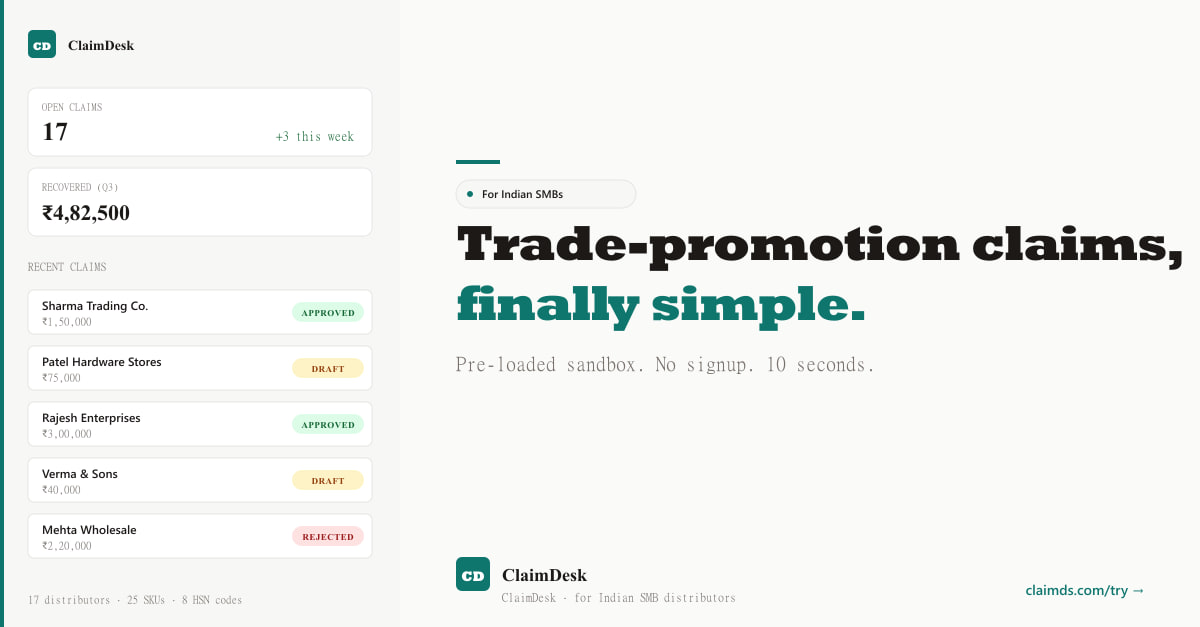
A partner's commission invoice should show the partner's name, GSTIN and PAN, an invoice number and date, a service description and period, the base commission as its own line, the GST rate and amount shown separately, and the total. The one detail that matters most: showing the base and the GST separately, so TDS is computed on the base — not the GST-inclusive total.
The fields a clean invoice needs
Source: ClaimDS — free to reuse with a link back to this article.
Why the format decides the tax
The invoice is not a formality; its layout decides how much you deduct. TDS on a commission is generally computed on the base commission, provided the GST is shown separately on the invoice. If the partner states a single figure — "commission ₹1,18,000" (illustrative) — with no breakup, the base is not identifiable and TDS can fall on the whole amount, over-deducting.
So the single most important formatting rule is: base commission on one line, GST on another, total below. The mechanics of the base-versus-GST calculation, with the rate and the worked example, are in the dedicated tax article — reviewed for accuracy by a chartered accountant — which this piece points to rather than restating.
<!-- TODO: link "TDS on the GST component of commission" (#153) and the tax pillar (#151) once they are out of draft. -->GSTIN and PAN
Two identifiers earn their place on the invoice. The partner's GSTIN lets the GST be accounted for and, where applicable, claimed. Their PAN matters because TDS provisions apply a higher rate where a PAN is not furnished — so capturing it up front avoids a surprise later. Confirm the exact requirements for your case with a professional.
Service description and period
Because a commission is a fee for a service, the invoice should describe the service and the period it covers — the business introduced, the orders procured, the referrals converted. A clear description supports the characterisation of the payment as a commission for a service and makes reconciliation to your records straightforward.
What TDS looks like in practice
TDS is usually not a line on the partner's invoice. The paying business deducts it from the payment, reflects it in the TDS return, and issues the partner a TDS certificate; the partner is paid the base plus GST minus the TDS. The invoice's job is simply to present the base and GST correctly so that deduction is right. The exact rate should be confirmed against the current law.
Read next
- Channel partner and sales-agent commission — the pillar.
- How to structure a commission agent agreement — the contract behind the invoice.
- Referral and channel-partner commission programs and C&F and DSA partner commissions.
- Incentive management software — computing the payout and TDS.
ClaimDS computes each partner payout, the TDS on the base commission and the partner's GST separately — so the invoice, the deduction and the payment reconcile the first time.
<!-- TODO: confirm capability wording with founder -->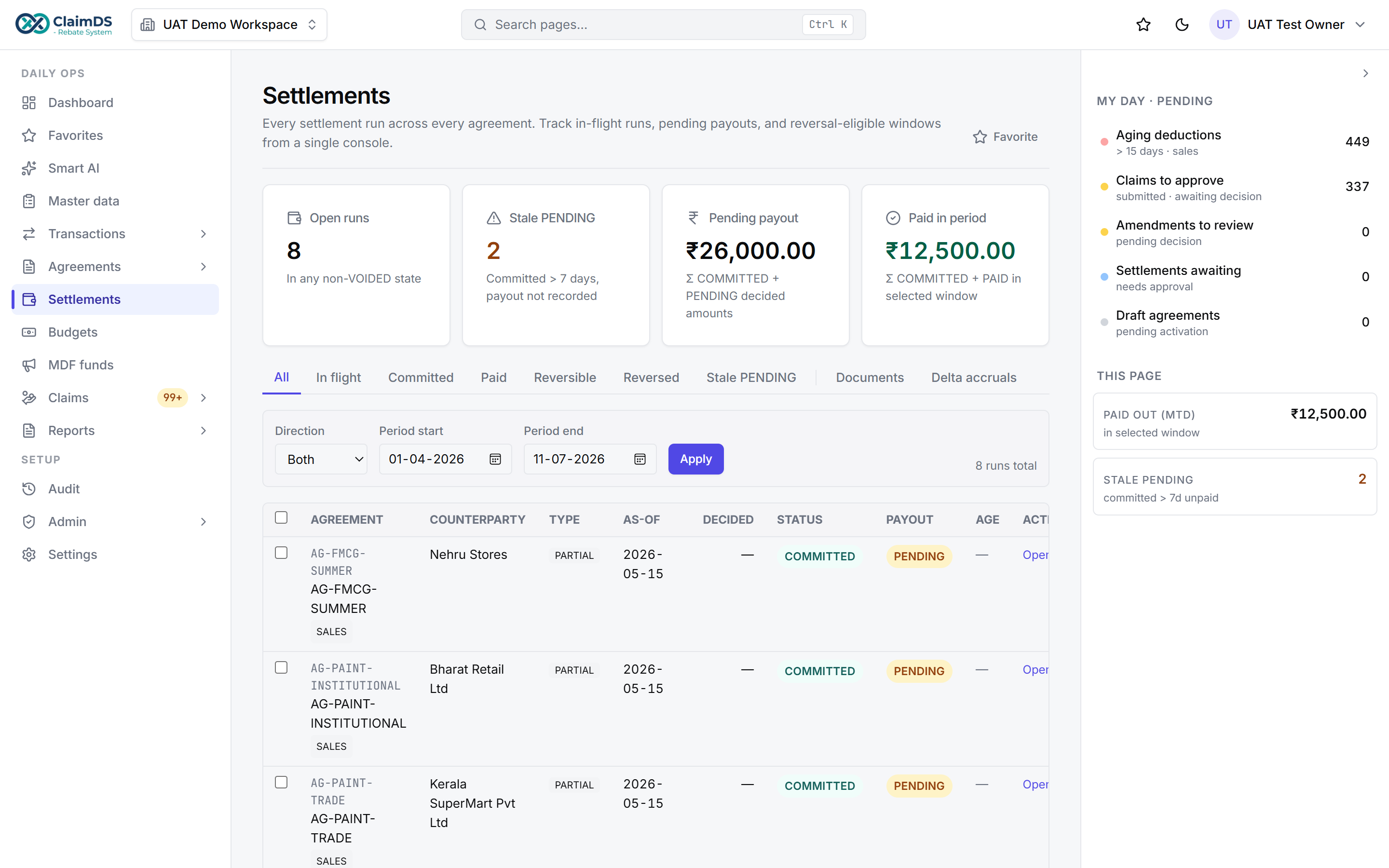
The ClaimDS settlement view — payouts calculated, approved and settled in one place.
Book a demo to see partner commission, TDS and GST computed and reconciled together.
Frequently asked questions
What should a commission invoice contain?
A commission invoice should show the partner's name and address, their GSTIN and PAN, an invoice number and date, a description of the service and period, the base commission as its own line, the GST rate and amount shown separately, and the invoice total. Separating the base and the GST lets TDS be computed correctly on the base.
Why should GST be shown separately on a commission invoice?
Because TDS on a commission is generally deducted on the base commission, not on the GST, where the GST is shown separately. If the invoice states a single figure without separating the GST, the base is not identifiable and TDS may fall on the whole amount. Showing GST separately protects the partner from over-deduction.
Does a commission invoice need a GSTIN and PAN?
A GST-registered partner's invoice should carry their GSTIN so GST is accounted for correctly, and their PAN matters because TDS provisions apply a higher rate where a PAN is not furnished. Capturing both on the invoice is what lets the paying business deduct TDS correctly and reconcile the GST — confirm the requirements with a professional.
How is TDS shown on a commission payment?
TDS is not usually a line on the partner's invoice; the paying business deducts it from the payment and reflects it in the TDS return, issuing the partner a TDS certificate. The invoice shows the base commission and GST; the business computes TDS on the base and pays the partner the balance. The exact rate should be confirmed against the current law.
What happens if a commission invoice is not formatted correctly?
If the base and GST are not shown separately, TDS may be over-deducted on the GST-inclusive total, and reconciliation becomes harder. If the GSTIN or PAN is missing, GST accounting and the TDS rate can be affected. A clean, correctly formatted invoice is what lets the payout, TDS and GST all reconcile without rework.
See ClaimDS on your own claims data
A 30-minute walkthrough tailored to how your channel actually settles claims.
Related posts

ASM and Field-Force Incentive Structures for Indian Distribution
How to structure incentives across a field sales hierarchy — sales officer, ASM and RSM — in Indian distribution, so each tier is paid on the right base.
How to Calculate Sales Incentives in Excel (and Where It Breaks)
A step-by-step way to calculate sales incentives in Excel — mapping, slabs, gates and payout — and the point at which a spreadsheet stops being safe to run on.
Paying C&F and DSA Partners: Commission for Carrying-and-Forwarding and Direct-Selling Agents
How carrying-and-forwarding (C&F) agents and direct-selling agents (DSA) are paid commission in India — two external partner types, clearly explained.