
Is a Sales Incentive Part of PF Wages?
Reviewed by CA Ramya · Last reviewed 16 Jul 2026
Whether a sales incentive or variable pay counts towards PF wages is contested and fact-specific. What the position turns on, and why to take professional advice.
Whether a sales incentive counts towards PF wages is contested and depends on the facts. PF contributions are anchored to basic wages; genuinely variable, performance-linked incentives paid to some employees are often treated as outside PF wages — but the treatment turns on how the incentive is structured, so take professional advice before deciding.
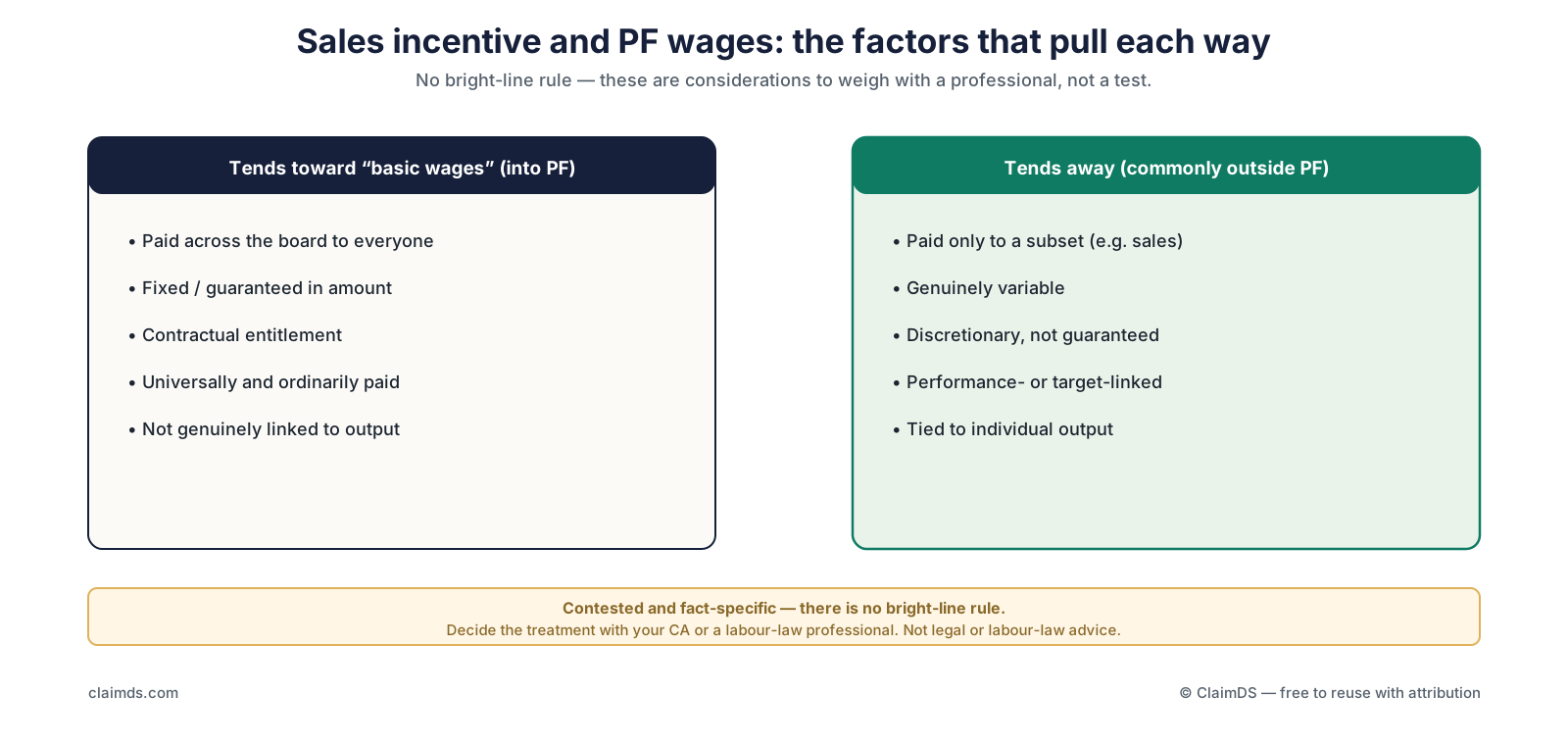
Source: ClaimDS — free to reuse with a link back to this article.
What counts as PF wages?
Provident fund contributions are calculated on basic wages together with dearness allowance. That much is settled. The difficulty — and the whole of the debate — is deciding whether a particular payment forms part of basic wages or is genuinely excluded from it.
There is no simple list. An allowance or incentive is not automatically in or out because of what it is called; the question is what it is in substance. This is why the treatment of variable pay and incentives is so often argued: the same payment can be characterised differently depending on how it is designed, and a bright-line rule that fits every payroll simply does not exist.
Where sales incentives usually sit
In practice, a genuinely variable, performance- or target-linked incentive paid to a subset of employees — a sales team, say — is commonly treated as not part of basic wages, and therefore outside PF. That is the common treatment, and the reasoning behind it is straightforward: the payment is not universal, it is not fixed, and it depends on individual output rather than being ordinary remuneration for the job.
But this is the common treatment and its rationale, not a guarantee. Whether it holds for a specific scheme depends on the facts of that scheme — and the position has been litigated, so it should be confirmed rather than assumed.
Why the answer is not the same for everyone
The factors that pull an incentive into or out of basic wages are worth weighing with a professional:
- Universality vs selectivity — paid to everyone, or only to some.
- Fixed vs variable — a guaranteed amount, or genuinely tied to output.
- Contractual vs discretionary — an entitlement, or paid at discretion.
- Ordinary vs performance-linked — part of the standard package, or earned on results.
None of these is decisive on its own, and two schemes that look similar on paper can be treated differently once these factors are applied. Present them to your advisor as considerations, not as a scoring test.
What this means for payroll
The practical posture is simple, even though the law is not:
- Decide the treatment with your CA or a labour-law professional, on the facts of your specific incentive scheme.
- Apply it consistently across employees in the same position.
- Document the basis so payroll and any future audit see the same reasoning.
ClaimDS keeps every channel scheme, claim and rebate — and how each is classified — in one auditable trail, so the settlement and its record reflect the same decision. The classification itself is one to take with a professional.
Read next
- How the same incentive is taxed for the employee — the tax pillar of this cluster.
- Rebate management — the product basics.
Note. This article is general information only. It is not tax, legal or labour-law advice, and it deliberately states no fixed rule on PF applicability. The treatment of a sales incentive for PF/EPF purposes is contested and fact-specific, and it must be confirmed with a qualified chartered accountant or labour-law professional before it is relied upon.
ClaimDS keeps each channel scheme, claim and rebate and its classification in one auditable trail, so settlement and record stay consistent — the discipline a clean tax-versus-payroll call on an incentive needs.
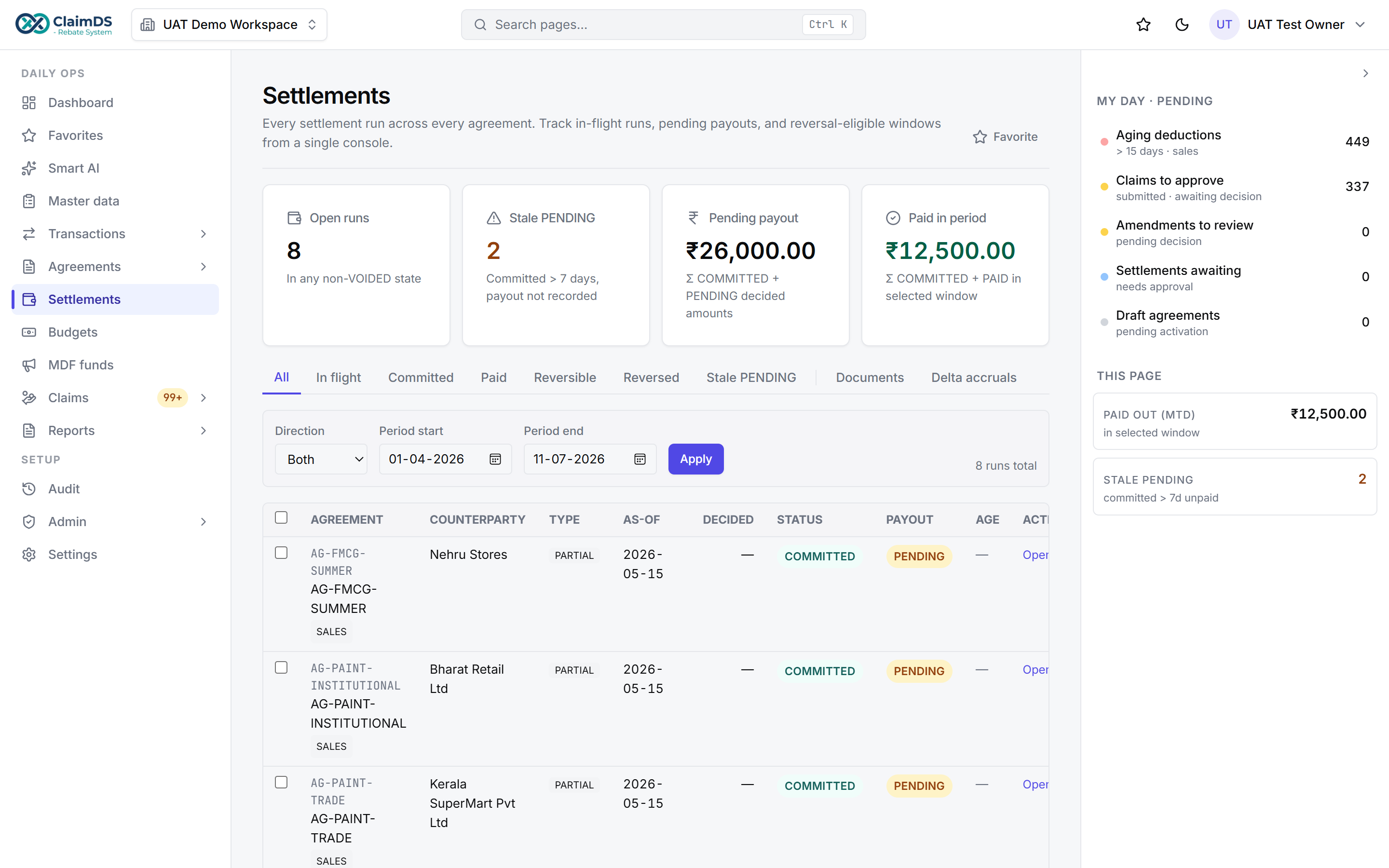
The ClaimDS settlement view — payouts calculated, approved and settled in one place.
Book a demo to see how ClaimDS records the tax and payroll treatment of each incentive alongside the payout.
Frequently asked questions
Is a sales incentive part of PF wages?
It is contested and fact-specific. PF contributions are anchored to basic wages, and a genuinely variable, performance-linked incentive paid to some employees is often treated as outside basic wages — but the treatment turns on how the incentive is structured. There is no bright-line rule, so take professional advice before deciding for your own payroll.
Is variable pay included in PF calculation?
It depends on the nature of the payment. PF is calculated on basic wages, and the question is always whether a given payment forms part of basic wages or is genuinely excluded. Truly variable, output-linked pay is commonly treated as outside basic wages, but this is fact-specific — confirm your position with a professional.
Are performance-linked incentives subject to PF?
Not by a fixed rule. Whether a performance-linked incentive counts towards PF wages turns on factors such as whether it is genuinely variable, paid selectively rather than across the board, and linked to output. Because these are questions of fact that have been litigated, take professional advice for your specific scheme rather than assuming an answer.
Is PF calculated on basic salary only?
PF contributions are anchored to basic wages together with dearness allowance. The practical difficulty is deciding whether a particular allowance or incentive forms part of basic wages or falls outside it, and that is exactly where the treatment of variable pay is contested. Take professional advice on how your salary structure should be treated.
Does a bonus attract PF?
It depends on the character of the bonus. Whether a bonus or incentive is part of basic wages for PF purposes is a fact-specific question that turns on how it is structured and paid, not on the name given to it. Because the position is contested and has been litigated, confirm the treatment of any bonus with a professional.
See ClaimDS on your own claims data
A 30-minute walkthrough tailored to how your channel actually settles claims.
Related posts

ASM and Field-Force Incentive Structures for Indian Distribution
How to structure incentives across a field sales hierarchy — sales officer, ASM and RSM — in Indian distribution, so each tier is paid on the right base.
How to Calculate Sales Incentives in Excel (and Where It Breaks)
A step-by-step way to calculate sales incentives in Excel — mapping, slabs, gates and payout — and the point at which a spreadsheet stops being safe to run on.
Paying C&F and DSA Partners: Commission for Carrying-and-Forwarding and Direct-Selling Agents
How carrying-and-forwarding (C&F) agents and direct-selling agents (DSA) are paid commission in India — two external partner types, clearly explained.