Deductions & short-payments
Deduction management software for Indian manufacturers
Every customer deduction and short-payment captured in one place, classified valid or invalid against the agreement, and either settled or disputed and recovered — instead of quietly leaking off your receivables.
14-day free trial · no credit card
What is deduction management software?
Deduction management software is the system that runs your whole deduction programme — capturing every customer deduction and short-payment taken off a payment, classifying each as valid or invalid against the underlying agreement, and driving the dispute and recovery of the invalid ones. It is built for Indian manufacturers and distributors facing secondary-scheme, damage, expiry, price-difference and short-payment deductions across a multi-tier channel, who today track them in email threads and spreadsheets.
The problem
When a customer or distributor takes a deduction, it arrives the wrong way round — as a short-payment already netted off a payment, not as a request you can approve or reject. By the time finance sees the bank line, the money is gone and the reason code is missing.
Unmanaged, that is pure revenue leakage. Secondary-scheme deductions, damage and expiry claims, rate-difference claims and plain unexplained short-payments pile up unclassified. Nobody has sorted the valid ones — where you genuinely owe a credit — from the invalid ones you should be disputing. So the invalid deductions get written off by default, because chasing each one by hand costs more than the line is worth.
And the recovery window is closing the whole time. A deduction you catch this month is a conversation; the same deduction six months later, buried under thousands of others, is a write-off. Without one place that captures every deduction the day it lands and tells you which ones to fight, the leakage is invisible until year-end — and by then it is permanent.
How ClaimDS manages deductions
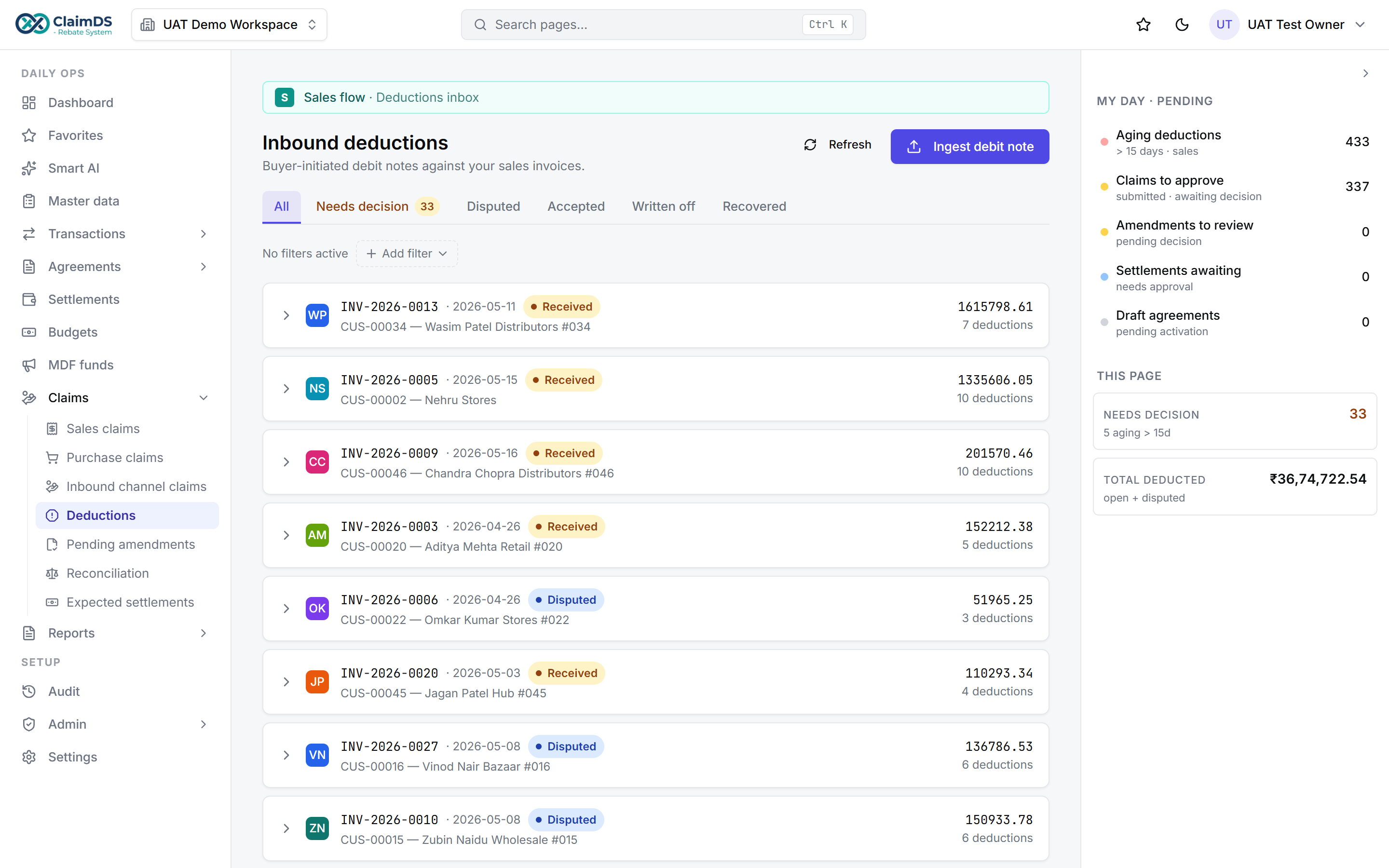
- 1. One deduction queue. Every customer deduction, short-payment and channel claim lands in a single workflow instead of scattered inboxes, bank statements and Excel sheets — so nothing leaks off a payment unseen.
- 2. Auto-match against agreements. Upload the deduction or claim file and ClaimDS matches each line against the relevant rebate, scheme or price-protection agreement automatically, so you review positions instead of re-keying them.
- 3. Classify valid vs invalid. ClaimDS surfaces which deductions agree with the agreement — a credit you genuinely owe — and which do not, so the invalid ones go to dispute rather than to a silent write-off.
- 4. Dispute and recover. Invalid deductions move through a dispute workflow with the basis attached, so you can recover the money back instead of absorbing it.
- 5. Settle the valid ones. Where a credit is genuinely due, ClaimDS settles it against the agreement with the correct GST credit note — the deduction, the agreement and the settlement all tracing back to one record.
- 6. Hash-chained audit & isolation. Every state change is written to a tamper-evident, hash-chained audit log, and PostgreSQL row-level security keeps your data isolated from every other company on the platform.
The matching step in the middle is a workflow in its own right — see claims and deduction reconciliation for how ClaimDS ties a partner file out line by line. If your deductions come mostly from modern-trade and large customers, see customer deduction and chargeback management.
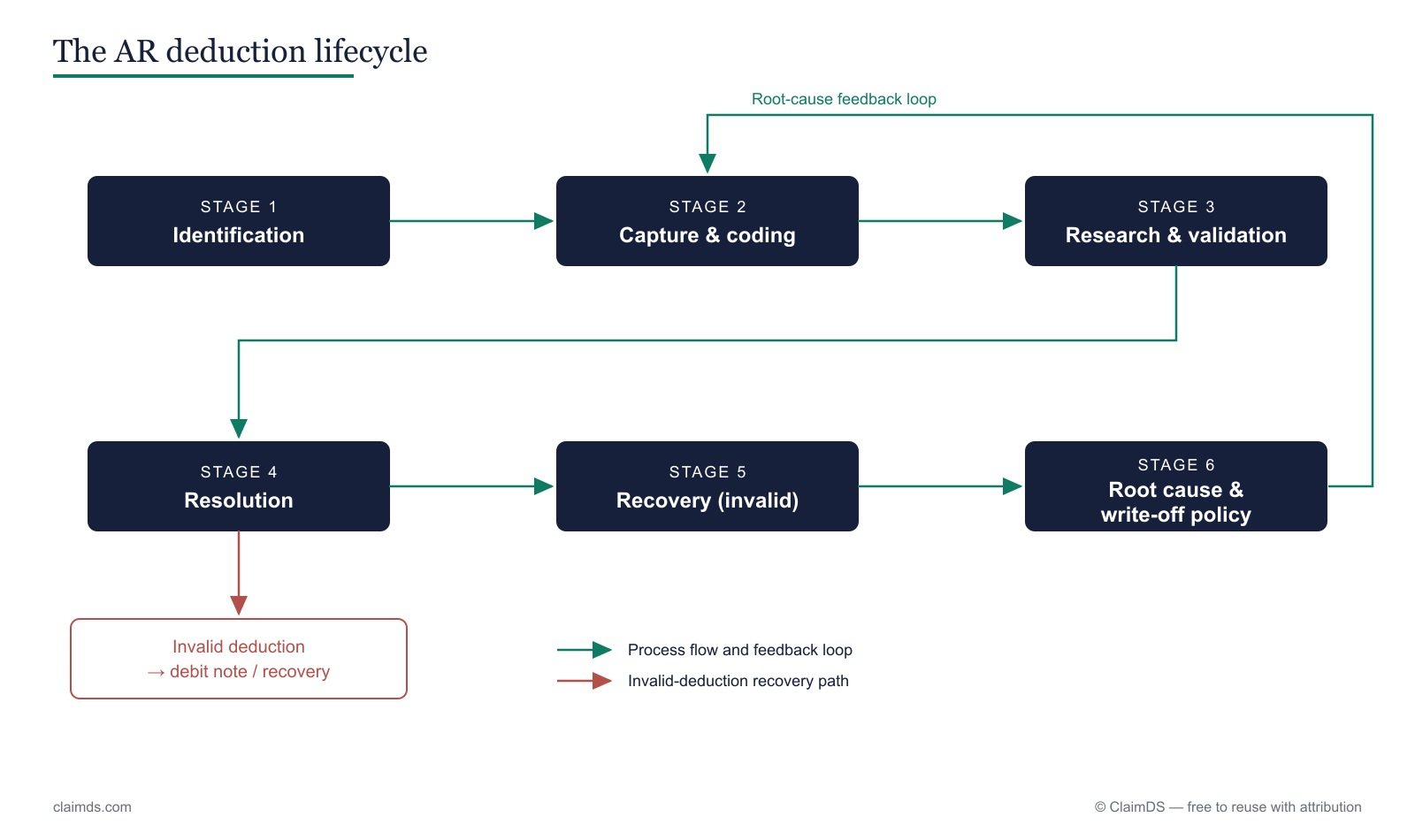
The deduction lifecycle
Built for the Indian channel
ClaimDS is India-first. Deductions here do not arrive as tidy chargebacks from one retailer — they come up through a multi-tier route-to-market, from super-stockists, distributors and dealers, as secondary-scheme deductions, damage and expiry claims and rate-difference claims. ClaimDS captures each against the tier and the scheme it belongs to, and settles the valid ones with the correct GST credit note rather than an ad-hoc adjustment.
A Western accounts-receivable deduction tool is built for a different world — retailer chargebacks, no secondary schemes, no GST credit-note settlement. A spreadsheet, meanwhile, captures nothing automatically and proves nothing later. ClaimDS sits in between: broad enough for the Indian channel’s claim types, priced for the mid-market, and grounded in the same agreements that drive your accruals and settlements.
Frequently asked questions
What is deduction management software?
It is software that runs the whole deduction programme for a manufacturer or distributor — capturing every customer deduction and short-payment taken off a payment, classifying it as valid or invalid against the agreement, and driving the dispute and recovery of the invalid ones. ClaimDS keeps all of that in one workflow instead of email and spreadsheets.
How is this different from claims and deduction reconciliation?
Reconciliation is the matching step — tying a partner file line by line to your agreements. Deduction management is the wider programme around it: capture, valid-vs-invalid classification, dispute and recovery. ClaimDS runs the reconciliation workflow inside the same product, so the two are one system, not two tools.
Which deductions and short-payments does it cover?
Secondary-scheme deductions, damage and expiry claims, price-difference and rate-difference claims, and unexplained short-payments a customer takes off an invoice. Each is captured, classified and settled against the agreement it belongs to, with a GST credit note where a settlement is due.
Can it tell a valid deduction from an invalid one?
ClaimDS matches each deduction against the relevant agreement and surfaces the ones that do not agree, so your team confirms what is owed and disputes what is not — instead of writing off invalid deductions because nobody had time to check them.
How do I know a settled deduction is defensible later?
Every state change — who captured, classified, disputed or settled a deduction — is written to a tamper-evident, hash-chained audit log. PostgreSQL row-level security isolates your data, so you can answer “who changed what, when” for any customer deduction in seconds.
What does deduction management software cost?
ClaimDS is priced for Indian mid-market manufacturers and distributors rather than global enterprises. Pricing depends on scale and the modules you turn on, so the honest answer is on the pricing page — see /pricing for current plans, or book a demo to scope your own volumes.
Stop writing off invalid deductions
Book a ClaimDS demo, or start a free trial and import your open deductions and agreements.