Modern trade & customer deductions
Customer deduction and chargeback management
Modern-trade and large-format-retail customers short-pay your invoices and charge back for schemes, damages and non-compliance. ClaimDS pulls every customer deduction into one queue, classifies it as valid or invalid against the agreement, and disputes the invalid ones with evidence — so wrongful short-payments get recovered instead of written off.
14-day free trial · no credit card
What is customer deduction and chargeback management?
It is the work of controlling the money your retail and modern-trade customers deduct from your invoices. Here a chargeback is a trade deduction a customer takes against an invoice — for a scheme claim, damage or non-compliance charge — not the consumer credit-card dispute of the same name. ClaimDS gathers every customer deduction and chargeback into one queue, classifies each as valid or invalid against the agreement, and moves the invalid ones into a documented dispute so the amount is recovered rather than silently absorbed.
The problem
A large-format retailer or modern-trade chain rarely pays your invoice in full. They deduct for the visibility scheme they ran, for damages and expiry at store, for shortages against the GRN, for listing and non-compliance charges, and for the secondary scheme they claim you owe. Each short-payment arrives as a line on a remittance with a code, not an explanation — and there are hundreds of them across dozens of customers every month.
Your team is expected to check each one against the agreement, find the invoice and proof of delivery, and either accept it or push back — usually inside a tight claim window the customer sets. When the volume is high and the evidence is scattered across email, the distributor management system and a shared drive, the honest deductions and the wrongful ones look identical. So the invalid ones get written off, not because they were right, but because chasing them by hand cost more than the amount. That leakage is invisible until someone adds up a year of it.
How ClaimDS manages customer deductions
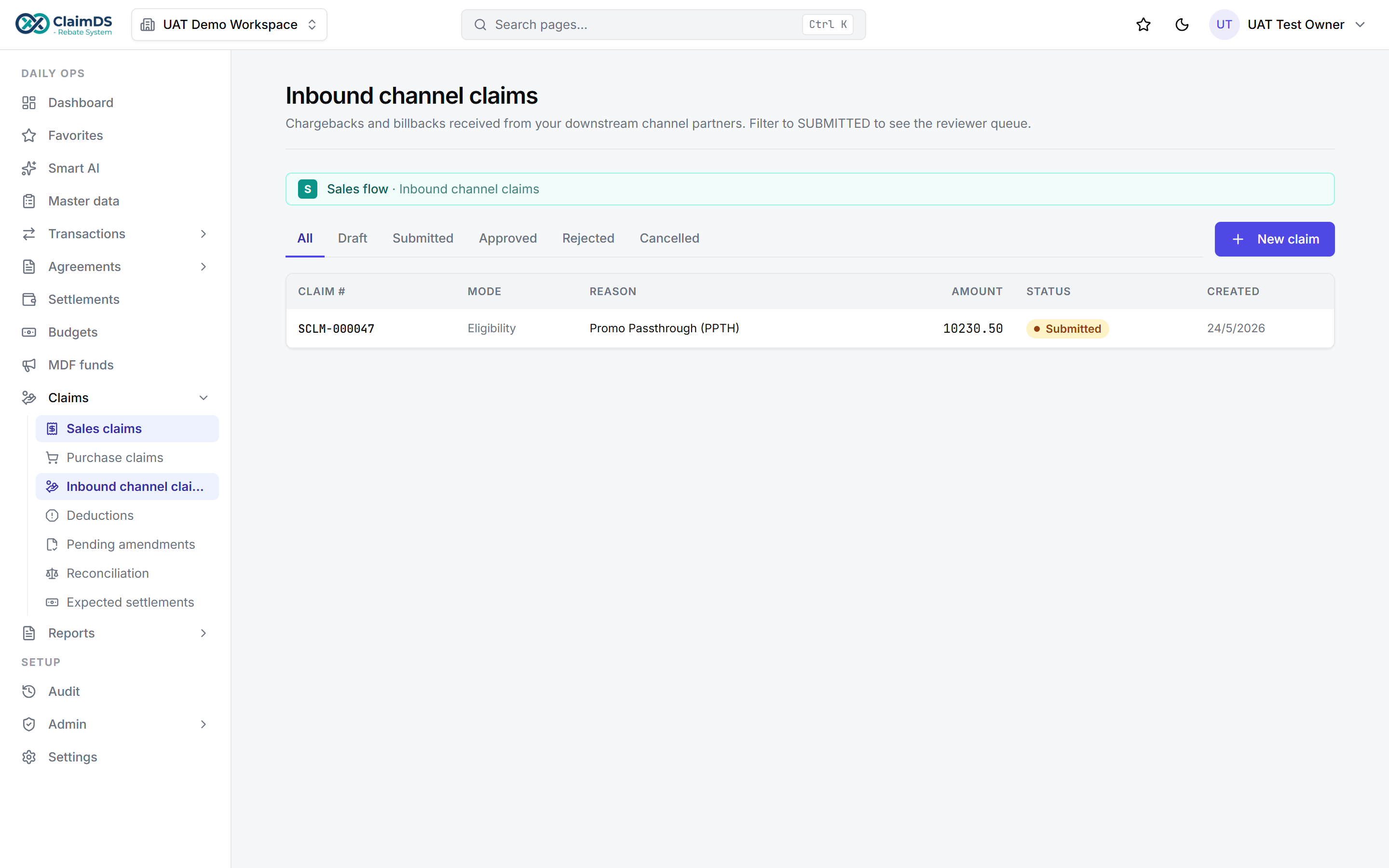
- 1. One customer-deduction queue. Every short-payment, chargeback and deduction from every modern-trade customer lands in a single queue instead of being buried in remittance PDFs and inboxes — so nothing ages out of its dispute window unseen.
- 2. Classify valid vs invalid. Each deduction is checked against the customer agreement and its supporting documents. A genuine scheme claim or agreed allowance is accepted; an unsupported, duplicate or excess short-payment is flagged invalid and routed to dispute.
- 3. Dispute with evidence. The dispute is built with its proof attached — invoice, proof of delivery, GRN, scheme terms — in the same record, so the customer receives a documented case rather than an email back-and-forth.
- 4. Auto-match against the agreement. Where the customer sends a claim or deduction file, ClaimDS matches it to your agreements automatically, so your team reviews only the lines that disagree instead of re-keying every row.
- 5. Recover and settle correctly. Accepted deductions settle through the right GST credit note; recovered amounts on overturned chargebacks are tracked back to closure.
- 6. Hash-chained audit + tenant isolation. Every classification, dispute and settlement decision is written to a tamper-evident, hash-chained audit log, and PostgreSQL row-level security keeps each company’s data fully isolated.
This is the customer-facing slice of ClaimDS’s broader deduction management software, and it shares the same match-and-reconcile engine behind claims and deduction reconciliation.
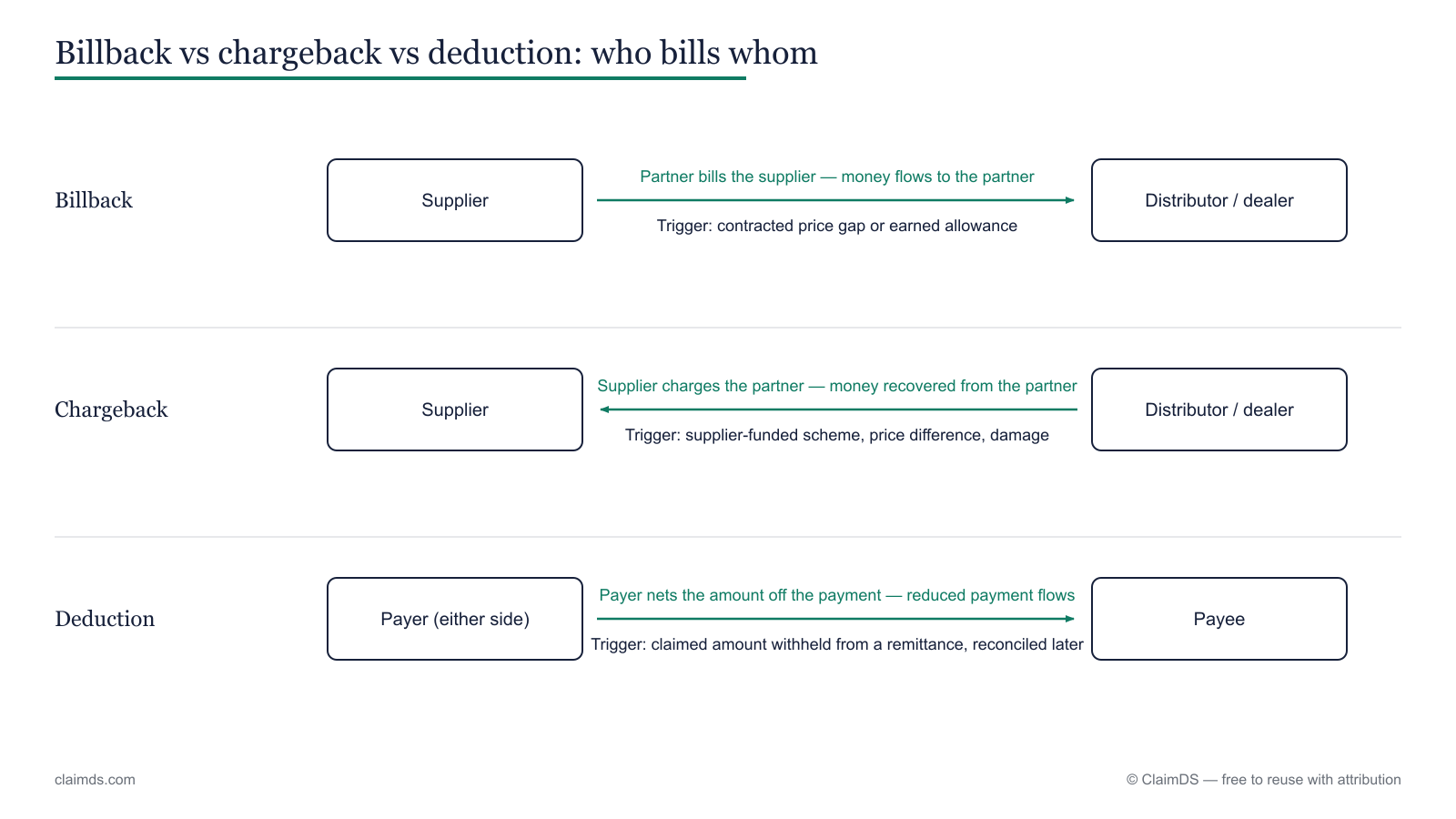
Billback, chargeback or deduction?
Built for the Indian channel
Customer deductions do not behave the same in modern trade and general trade. A large-format-retail or modern-trade customer deducts against invoices with formal claim codes and tight windows; a general-trade distributor claims through your secondary scheme flow. ClaimDS keeps the two separate instead of forcing both through one accounts-receivable screen, so the customer-side deduction has the right agreement, evidence and settlement path behind it.
When a deduction is agreed, it settles through the correct GST credit note — not an informal adjustment that leaves your tax position and the customer’s books out of step. That is the gap a Western AR tool or a shared spreadsheet leaves open: they assume a different tax model, they have no concept of the Indian multi-tier channel, and they cannot tie a short-payment back to the scheme agreement that justifies it. ClaimDS is India-first and priced for mid-market businesses, which is why it fits the modern-trade deduction problem that generic finance tools were never shaped for.
Frequently asked questions
What is a customer chargeback?
In the trade sense used here, a customer chargeback is a deduction a retailer or modern-trade customer takes against your invoice — for a scheme claim, damage, shortage or non-compliance charge. It is not the consumer card-payment dispute of the same name. On ClaimDS it lands as a short-payment you classify, dispute or accept.
How is this different from your deduction management software?
Our broader deduction-management software runs your whole deduction programme across the channel. This page is the customer side of it: the modern-trade and large-format-retail buyers who short-pay and charge back against invoices. Same platform, narrower job — retailer deductions classified, disputed and recovered.
Can ClaimDS tell a valid deduction from an invalid one?
You classify each customer deduction against the underlying agreement and supporting documents — a valid scheme claim or agreed damage allowance is accepted, while an unsupported or duplicate short-payment is marked invalid and moved into dispute. The point is that nothing is written off by default just because chasing it is tedious.
How do we dispute a wrongful chargeback?
Build the dispute with its evidence attached — the invoice, proof of delivery, the scheme terms — inside the same record, then work it to resolution. Because the classification and the evidence live together, the customer sees a documented case rather than an email argument, which is what shortens the recovery cycle.
Does it fit Indian modern trade and GST?
Yes. ClaimDS is India-first: it separates modern-trade customers from general-trade distributors, and agreed deductions settle through the correct GST credit note rather than an informal adjustment. A Western accounts-receivable tool assumes a different tax and channel model.
What does it cost?
Pricing is published on our pricing page rather than quoted case by case here. ClaimDS is positioned for Indian mid-market businesses, not enterprise-only budgets. See the plans and start a trial or book a demo to size it against your own deduction volume.
Recover the deductions you are writing off
Book a ClaimDS demo, or start a free trial and load a month of customer deductions to see what is valid, what is not, and what is recoverable.