
How Stock Compensation Claims Interact With the Rebate Process
How channel stock-compensation claims interact with rebate calculations — compensated stock reducing eligible purchases, avoiding double-benefit, and keeping both ledgers consistent.
Channel stock compensation, not employee equity. This article is about compensating distributors and dealers for damaged, expired, price-protected or short-supplied stock — not ESOPs, equity awards or share-based compensation. Those are an unrelated category and are not covered here.
Stock compensation interacts with the rebate process because compensated stock often shouldn't count toward rebate-qualifying purchases. A compensation claim can shrink the net eligible base and move a partner into a different rebate slab — so the two ledgers have to be reconciled, sequenced correctly, and kept free of double-benefit.
Why the two ledgers touch
Rebates accrue on qualifying purchases; stock compensation pays a partner back for stock that lost value. If a partner is compensated for stock they also earned rebate on, the same units effectively pay twice. That overlap is why stock compensation and the rebate management process can't be run in separate spreadsheets. This is the process companion to the stock-compensation solution page — it explains the interplay, not the capability.
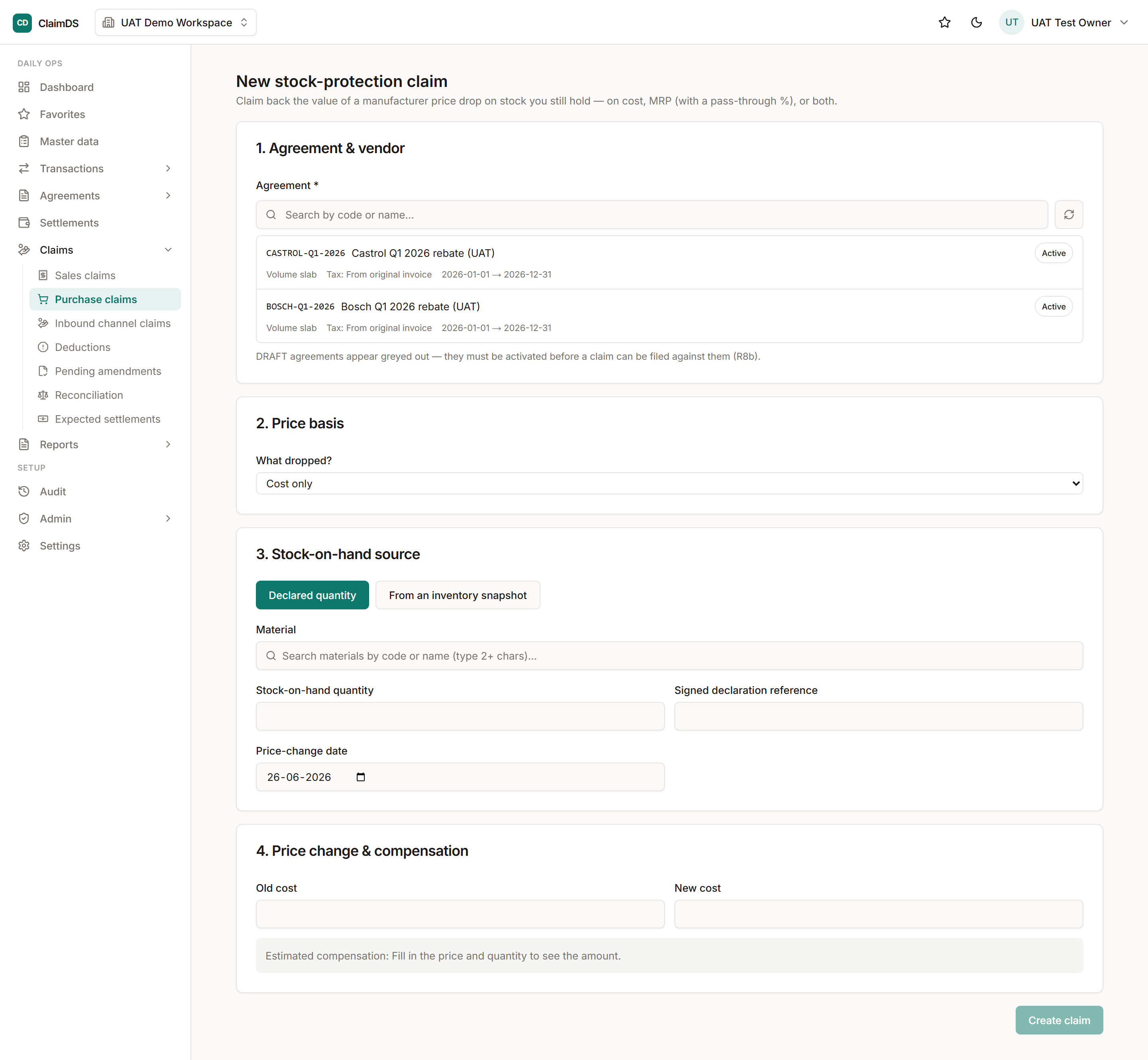
Compensated stock reduces the eligible base
When stock is compensated — via buyback of expired/damaged goods, or price protection on a price cut — those units usually shouldn't inflate a rebate slab. Net eligible purchases = gross qualifying purchases − compensated stock. Miss that subtraction and you over-pay the rebate. The slab mechanics are in volume rebates.
Sequencing: compensation before rebate computation
Settle (or at least record) the compensation before you finalise the rebate. If the rebate is computed first and compensation lands after, the slab may need re-opening — a reconciliation headache and a dispute risk. Sequencing compensation first keeps the rebate base honest from the start.
A worked (illustrative) slab recalculation
Illustrative only. A distributor's gross qualifying purchases are ₹52,00,000 — just over a 2% slab at ₹50,00,000. A ₹4,00,000 expiry-compensation claim reduces net eligible purchases to ₹48,00,000, dropping them below the 2% slab to 1.5%. Computed without the adjustment, the rebate over-pays; computed with it, both ledgers reconcile. This kind of silent gap is a source of revenue leakage in rebate programs.
Keeping both consistent with automation
Holding rebates and stock compensation in one system means a compensation claim automatically adjusts the rebate base and triggers a slab re-check, with an audit trail on both sides. The accounting treatment is in rebate accounting.
Where ClaimDS fits
ClaimDS keeps rebates, stock compensation, buyback and price protection in one claim ledger, so compensated stock adjusts the rebate base by rule and double-benefit is prevented — India-first, at a mid-market price (a ClaimDS-supplied ~₹3–5 lakh/yr figure, positioning not a benchmark).
GST note: Stock compensation settles via credit notes — see financial vs. tax credit notes. General information, not tax advice.
Frequently asked questions
How does stock compensation affect the rebate process?
When a distributor is compensated for damaged, expired, price-protected or short-supplied stock, that stock often shouldn't count toward rebate-qualifying purchases. So a compensation claim can reduce the net eligible base and change which rebate slab a partner lands in — which is why the two must be reconciled, not run separately.
What is the double-benefit risk between rebates and stock compensation?
Double-benefit happens when a partner earns a rebate on stock that is later compensated (returned, expired or price-protected) — effectively getting paid twice on the same units. Avoiding it means sequencing compensation and rebate computation so compensated stock is removed from the rebate base.
How do you keep rebate and stock-compensation ledgers consistent?
By holding both in one system so a compensation claim automatically adjusts the rebate-eligible base and triggers a slab re-check. Run separately, the two drift apart and either over-pay (double-benefit) or dispute; run together, the numbers reconcile by rule.
See ClaimDS on your own claims data
A 30-minute walkthrough tailored to how your channel actually settles claims.
Related posts

How Rebate Schemes Work for Online Sellers & E-Commerce Channels in India
How rebate and incentive schemes work for India's e-commerce channel — brands running schemes for marketplace/D2C sellers, and sellers reconciling rebates against platform deductions.
Rebate Software Pricing in India: Cost Models, TCO & How to Compare Plans
How to compare rebate software pricing in India — the common cost models, what drives price, hidden costs, a TCO worksheet, and where to find independent reviews.
Sell-In Rebate Strategy: How to Incentivize Channel Partners Without Channel Stuffing
How sell-in rebates motivate channel partners — and how to design one without channel stuffing, using sell-through conditions, caps, healthy-inventory clauses and growth structures.